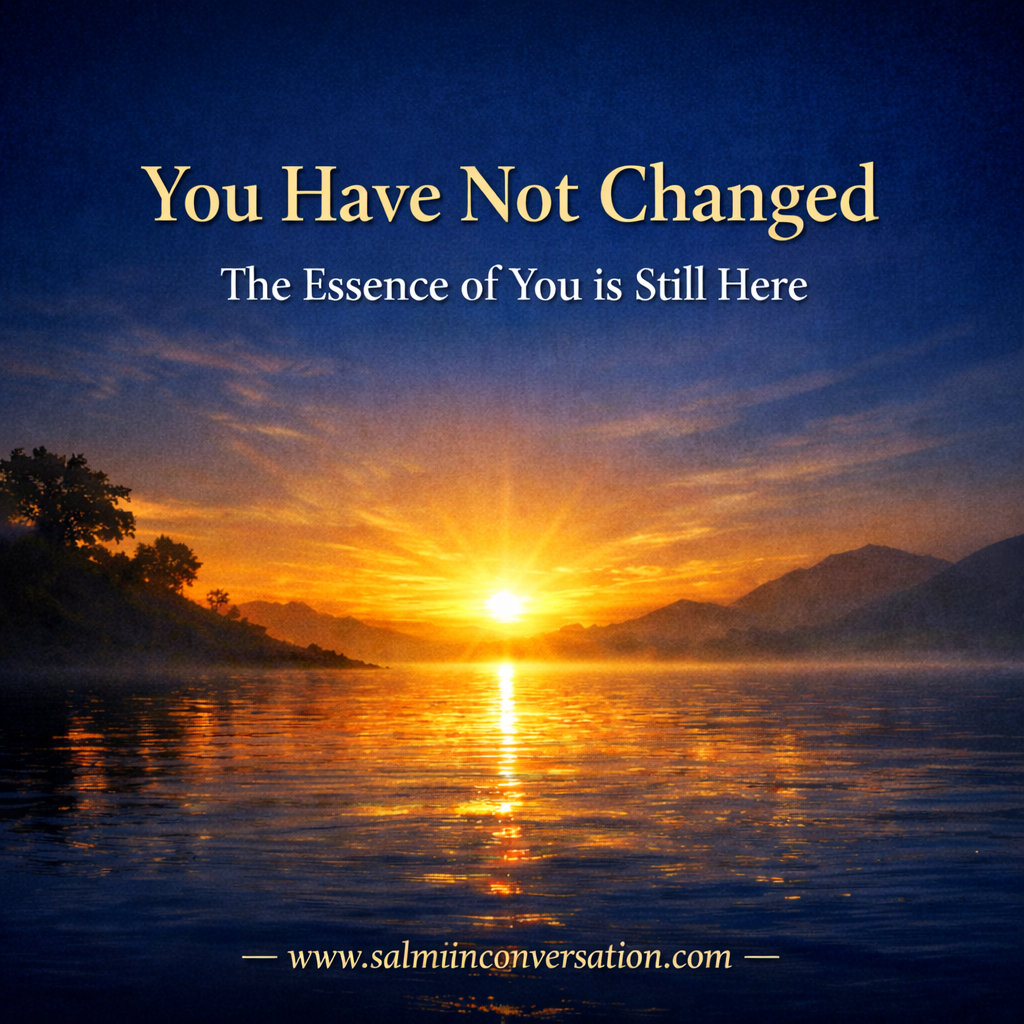
You Have Not Changed
Yaar… tum badley nahi. The sentence followed me across decades and continents — and it eventually forced me to ask a deeper question: what actually changes in a life?
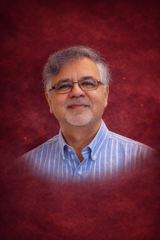

A Tribute to the Sacred Cord By Salmi
"Yaar… tum badley nahi.”
My friend, you have not changed.
Across the years — and across continents — this sentence has followed me quietly.
Not once.
Not occasionally.
But repeatedly, lovingly, almost with relief.
Childhood friends say it when we reconnect — friends from Tarbangla, from Minto Circle, from the intellectual corridors of Aligarh Muslim University. People who knew me before professions, before migrations, before life unfolded across five continents and seven decades.
They say it freely.
Frankly.
Sometimes with pleasant surprise.
And each time I hear it, I pause.
Because I understand what they mean — and what they do not mean.
They are not speaking about appearance. Time has done its honest work there.
They are speaking about something less visible: the manner of connecting, the instinct to relate before judging, the warmth of conversation that still feels familiar to them.
Before going further, one clarification is important.
This reflection is not self-praise.
Nor is it an announcement.
It is simply an attempt to understand why certain things in a life remain unchanged even when everything else evolves.
No Certification for the Soul
Whenever friends repeat that familiar line — “Tum badley nahi” — I often respond with gentle humour.
I tell them I have not yet discovered any vocational training course, academic credential, professional certification, or algorithm capable of teaching a person how to change the soul.
We learn skills.
We acquire knowledge.
We adapt to technologies and environments.
But where does one enroll to relearn one’s essence?
There are institutions for competence.
None for continuity of being.
The Sacred Cord
The truth may be simpler.
My roots were never external decorations.
They became circulation itself — flowing quietly through the veins of my existence.
There exists an invisible cord tying me to my mother and father. A sacred cord that nourished long before I understood nourishment, guided long before I understood direction.
That cord was never severed.
My parents do not need to travel from their resting place to check whether I have changed.
They live within me.
In gestures I never consciously practiced.
In pauses before speaking.
In respect offered naturally rather than performed.
What loves us first often becomes what remains within us longest.
Change — Into What?
The modern world celebrates change as proof of progress.
But across decades of experience, I have often asked myself a quieter question:
Change into what?
Life certainly changed my surroundings — cities, cultures, professions, institutions, technologies.
Storms came.
Continents changed.
But the roots held.
Yet the center remained still.
Growth expanded outward.
Anchoring remained inward.
The world added layers to experience without replacing the foundation beneath it.
Perhaps maturity is not becoming someone else.
Perhaps it is becoming more faithfully who you already were.
A Journey That Never Left Home
Seven decades form a long journey.
Five continents form a wide geography.
Yet distance never dissolved belonging.
Every arrival carried echoes of earlier departures.
Every new beginning carried memory as silent luggage.
The farther I travelled, the clearer my origins became — like a tree discovering the depth of its roots only when winds grow stronger.
The journey did not take me away from home.
It revealed how deeply home had already taken residence within me.
What Prevented the Wrong Change
When someone says “You have not changed,” another question naturally follows.
What pressures existed that might have changed me?
Life across decades never unfolds without storms.
Professional responsibilities bring expectations.
Institutions bring pressures.
Success often invites subtle compromises.
In such moments, change can move in two directions.
One can grow toward clarity —
or drift away from oneself.
Looking back, I realize something simple protected me.
Roots.
Not romantic roots, but the lived discipline of them.
Storms may shake branches.
But storms do not uproot a tree whose roots grow deep.
The Inheritance That Matters
Not every inheritance arrives in visible form.
What I received early in life was something quieter:
an innate desire to be of help to others,
and an insatiable curiosity to remain relevant and reliable in whatever responsibility life entrusted to me.
This was not ambition in the conventional sense.
It was nourishment.
My parents did not impose external expectations upon me. Instead, they nurtured something deeper — the discipline of becoming the best I could be for the benefit of others.
Expectation pressures the mind.
Nourishment strengthens the soul.
Around this early foundation grew a wider support system — teachers who encouraged curiosity, friendships that preserved authenticity, and environments that reinforced dignity in human relationships.
These influences became the unseen architecture of a life.
The Smile Within the Journey
There is another element friends recognize when they say:
“Yaar… tum badley nahi.”
It is not criticism.
If anything, it is their affectionate validation of continuity.
They remember the boy from a small town — curious, talkative, sometimes mischievous, always ready to turn serious moments into conversation.
Somewhere along the road from those early days to five continents of travel and work, that spirit never disappeared.
My andaaz-e-bayaan — my style of expression — has always carried a mixture: seriousness wrapped gently in humour.
For me, conversations were never meant to be battles of opinion.
They were bridges.
Even disagreements could remain respectful, sometimes softened by a smile, sometimes by a remark that turned tension into shared laughter.
Friends laughed.
Even those who disagreed rarely felt unwelcome.
And perhaps that is why the line returns again and again:
“Yaar… tum waqai badley nahi.”
Because somewhere within the adult who travelled the world, the child who once laughed easily in a small town continues to live.
A Conversation Across Generations
After seven decades of walking through life’s landscapes — from a small town to five continents — I find myself thinking about the generations beginning their journeys today.
Not from a position above them.
But simply from further along the same road.
Behind me are seventy years of experience.
Ahead of many young people lie seventy years still unfolding.
Between these horizons lies a bridge.
Conversation.
I do not offer instructions.
Every generation must discover its own path.
What I can offer is sharing.
That success without character feels hollow.
That knowledge without humility becomes noise.
That speed without reflection can easily lose direction.
And that roots — quiet, invisible roots — matter more than we often realize.
Technology will change.
Careers will change.
Even the meaning of work may evolve.
But the inner compass that guides a human life — integrity, curiosity, empathy, dignity — remains timeless.
If these reflections from seventy years of life offer even a small lantern along the road, then this conversation has already served its purpose.
The Meaning of “Not Changing”
Perhaps when people say “You have not changed,” they are not describing a person.
They are recognizing continuity.
In a restless world that often celebrates reinvention, continuity has become rare.
Yet to remain connected to one’s beginnings is not stagnation.
It is alignment.
Not rigidity.
But remembrance.
The Tribute
This reflection is not about me.
It is a tribute.
To parents whose teachings required no speeches.
To teachers who quietly shaped curiosity.
To friendships that preserved authenticity across decades.
If something in me appears unchanged, it is because love proved stronger than time.
Some journeys expand the world.
Some journeys protect the soul.
The fortunate ones do both.
And somewhere between roots and roads,
the sacred cord continues to live.
Salmi
Roots as compass. Wings as journey.
Five decades. Five continents. One continuing conversation with life.
🇨🇦 www.salmiinconversation.com
🇨🇦 www.salmizindagi@substack.com