Knowledge and Information — and In Between
In an age flooded with information, something essential risks being lost: understanding. This reflection explores the quiet space between data, knowledge, and lived wisdom.
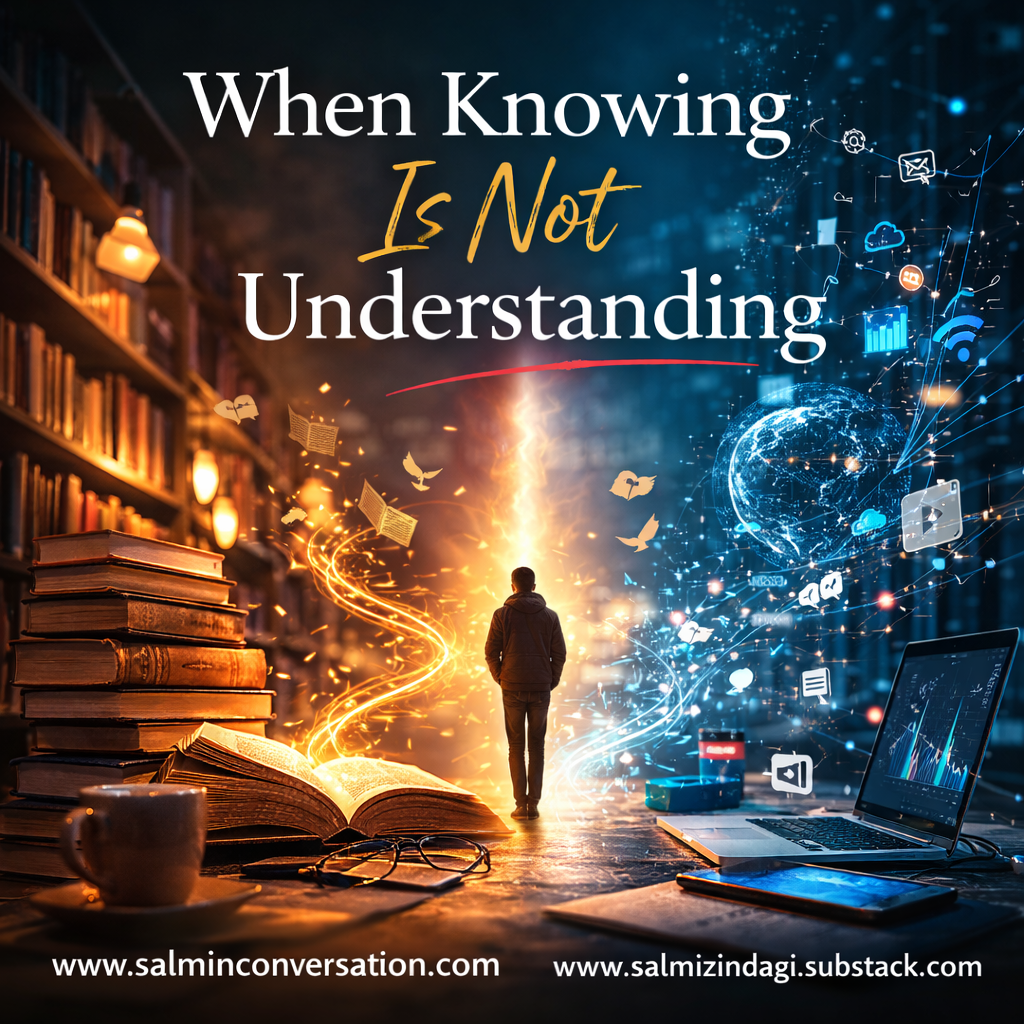
When Knowing Is Not Understanding
Life, Learning, and the Quiet Distance Between Data and Wisdom
Sulaiman Nasir (Salmi)
There was a time when knowledge traveled slowly.
It lived in books, in teachers, in conversations, and often in silence between words.
Learning required patience.
Understanding required reflection.
To know something was not merely to encounter it — it was to live with it long enough for meaning to emerge.
Today, knowledge appears everywhere.
Information travels instantly across continents, screens, and clouds.
We accumulate facts faster than any generation before us.
Yet something curious has begun to happen.
We know more — and understand less.
The Age of Information
The modern world has achieved a remarkable triumph: information abundance.
Libraries that once filled buildings now fit inside a pocket.
Search engines answer questions in seconds.
Artificial intelligence can generate explanations, summaries, and analysis almost instantly.
Humanity has never possessed so much information.
But information alone does not become knowledge.
Information is movement.
Knowledge is digestion.
Information arrives quickly.
Understanding grows slowly.
The difference between the two is not speed, but depth.
When Knowing Becomes Collection
Modern education often rewards accumulation.
Students gather data, citations, and credentials.
Organizations measure expertise through degrees and certificates.
Knowledge begins to resemble inventory.
The more one collects, the more competent one appears.
Yet knowledge without reflection can quietly become noise.
Facts accumulate without forming meaning.
Concepts remain disconnected from experience.
The mind fills, but the self remains unchanged.
To know something intellectually is not always the same as understanding it humanly.
The Forgotten Middle
Between information and wisdom lies a quiet territory rarely discussed.
That territory is understanding.
Understanding is where knowledge meets life.
It requires time, patience, and often discomfort.
Understanding asks questions that information alone cannot answer.
What does this mean for how we live?
What does this change in how we see others?
What responsibility emerges from what we now know?
Without this middle space, knowledge becomes mechanical.
With it, knowledge becomes transformative.
The Illusion of Instant Knowledge
Digital culture encourages immediacy.
Answers arrive instantly.
Opinions form quickly.
Certainty appears within moments.
But real understanding resists acceleration.
It grows through reflection, through dialogue, through the quiet friction between experience and thought.
A book read slowly often teaches more than ten articles scanned quickly.
A conversation held with attention may reveal more than a thousand posts shared online.
Understanding does not arrive in a download.
It emerges through lived engagement.
Knowledge and Haqīqat
In many intellectual traditions, knowledge was never separated from lived reality.
To know something was also to be transformed by it.
Information describes the world.
But haqīqat (lived reality) reveals what the world means for the human being within it.
A person may know the definition of compassion.
But compassion becomes real only when it is practiced.
One may understand the concept of justice.
Yet justice acquires meaning only when it shapes action.
Knowledge informs the mind.
Haqīqat reshapes the person.
The Responsibility of Knowing
Perhaps the greatest question of knowledge is not what we know, but what our knowing does to us.
Does knowledge deepen humility?
Does it expand empathy?
Does it connect us more carefully to the lives of others?
If knowledge produces arrogance, it has not yet matured into understanding.
If knowledge produces wisdom, it begins to approach haqīqat.
The journey from information to wisdom is therefore not merely intellectual.
It is profoundly human.
Returning to Understanding
The challenge of our age may not be acquiring more information.
We have already succeeded at that.
The deeper task may be learning how to live with what we know.
To pause before conclusions.
To reflect before judgment.
To listen before speaking.
Understanding grows where knowledge is allowed to breathe.
And when knowledge finally touches lived reality, information becomes insight — and insight becomes wisdom.
This essay continues a four-part reflection on human roots, knowledge, and lived experience.
Next: Survival of the Weakest — AI, Credentials, and the Fragility of Modern Systems.
Let’s continue the conversation.
© 2026 Sulaiman Nasir | Life in Conversation with Salmi
All original writing, narration, and visual concepts remain the intellectual property of the author. Unauthorized reproduction, adaptation, distribution, or use of this work is prohibited.
🇨🇦 www.salmiinconversation.com
🇨🇦 https://salmizindagi.substack.com