Asha Bhosle — When a Voice Becomes an Era
A remembrance of music, memory, and the quiet companionship of a lifetime For many listeners across generations, Asha Bhosle was never merely a singer.

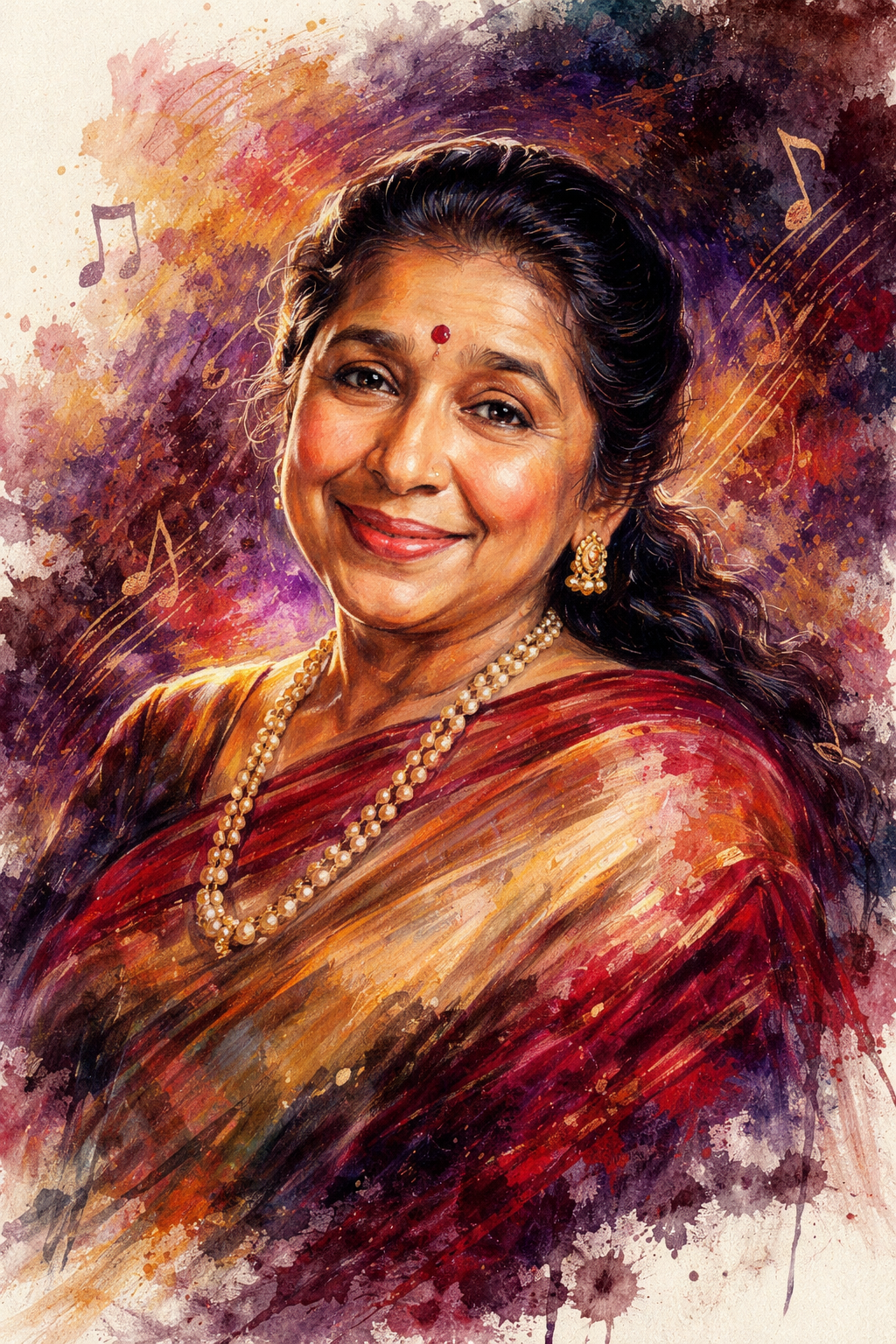
Sulaiman Nasir (Salmi)
She was a presence.
A quiet, enduring companion in the background of life itself — accompanying moments we did not even realize were slowly becoming memories.
Her voice travelled through homes, radios, vinyl records, cassettes, wedding halls, late-night drives, and quiet afternoon radios resting on windowsills. It carried laughter, mischief, romance, longing, resilience, and sometimes a playful rebellion that only great artists know how to express.
Many singers perform songs.
Very few inhabit life through sound.
Asha Ji did exactly that.
A Voice That Travelled Through Time
Across decades, languages, and changing musical eras, she remained not merely relevant — but vibrantly alive in spirit.
Her voice possessed a rare balance.
It could be youthful without being naïve.
Playful without losing depth.
Emotional without ever becoming heavy.
That balance is not merely technique.
It is intuition.
It is the instinct of an artist who understands that music is not only heard — it is lived.
For those of us who grew up listening to her, she became something far more intimate than a performer.
She became part of the emotional architecture of our lives.
Her songs appeared quietly in the background of childhood, youth, friendships, celebrations, heartbreaks, and moments of quiet reflection.
And when we hear those melodies again decades later, something extraordinary happens.
It is not merely music we hear.
It is time returning to visit us.
That is the power of an artist who becomes an era.
The Human Spirit Behind the Voice
What makes her journey even more remarkable is the human spirit that carried the music.
Longevity of that magnitude does not emerge from talent alone.
It grows from curiosity.
From resilience.
From humility.
From an endless willingness to continue exploring new expressions of art.
Across changing generations of music directors, evolving recording technologies, and shifting musical tastes, she adapted with grace.
She experimented.
She collaborated.
She remained vibrant.
In an industry constantly reinventing itself, she remained not only present — but unmistakably alive.
When an Artist Becomes an Institution
Very few artists become legends.
Even fewer become institutions of culture.
Asha Bhosle belongs to that rare constellation of human beings whose art quietly shapes generations without ever announcing its greatness.
Her voice crossed borders of language, culture, and geography.
It entered millions of homes — not as spectacle, but as companionship.
And that may be the true mark of enduring art.
Music as Memory
Music is never only entertainment.
It becomes memory.
It becomes a bridge between generations.
Sometimes it even becomes a silent teacher of emotion — teaching us how to laugh, love, ache, celebrate, and remember.
For many of us, Asha Ji will never simply belong to musical history.
She belongs to our personal history.
Her songs carry fragments of our own lives within them.
The Quiet Immortality of a Voice
Some voices fade with time.
Some voices grow deeper roots in the human heart.
Her voice belongs to the latter.
An era, indeed.
© 2026 Sulaiman Nasir | Life in Conversation with Salmi
All original writing, narration, and visual concepts remain the intellectual property of the author. Unauthorized reproduction, adaptation, distribution, or use of this work is prohibited.
🇨🇦 www.salmiinconversation.com
🇨🇦 https://salmizindagi.substack.com