Just One Drop of a Tear
From scarcity to the AI era, the human heart still speaks the same ancient language — sometimes through just one drop of a tear.
An Evolution of Generations — from scarcity to algorithms, the human heart still speaks the same language
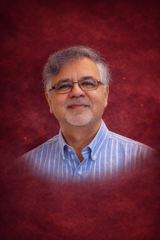
By Sulaiman Nasir (Salmi)
Life in Conversation with Salmi
Just One Drop of a Tear
The Smallest Honest Thing
Modern life is full of performances.
We perform competence.
We perform success.
We perform confidence.
In the age of constant visibility, people often learn to curate their lives carefully — choosing what to show and what to hide.
Yet amid all these performances, there remain a few signals that cannot easily be rehearsed or edited.
A tear is one of them.
A tear does not negotiate with the mind.
It does not wait for approval.
It does not brand itself for public display.
It simply arrives.
Quietly.
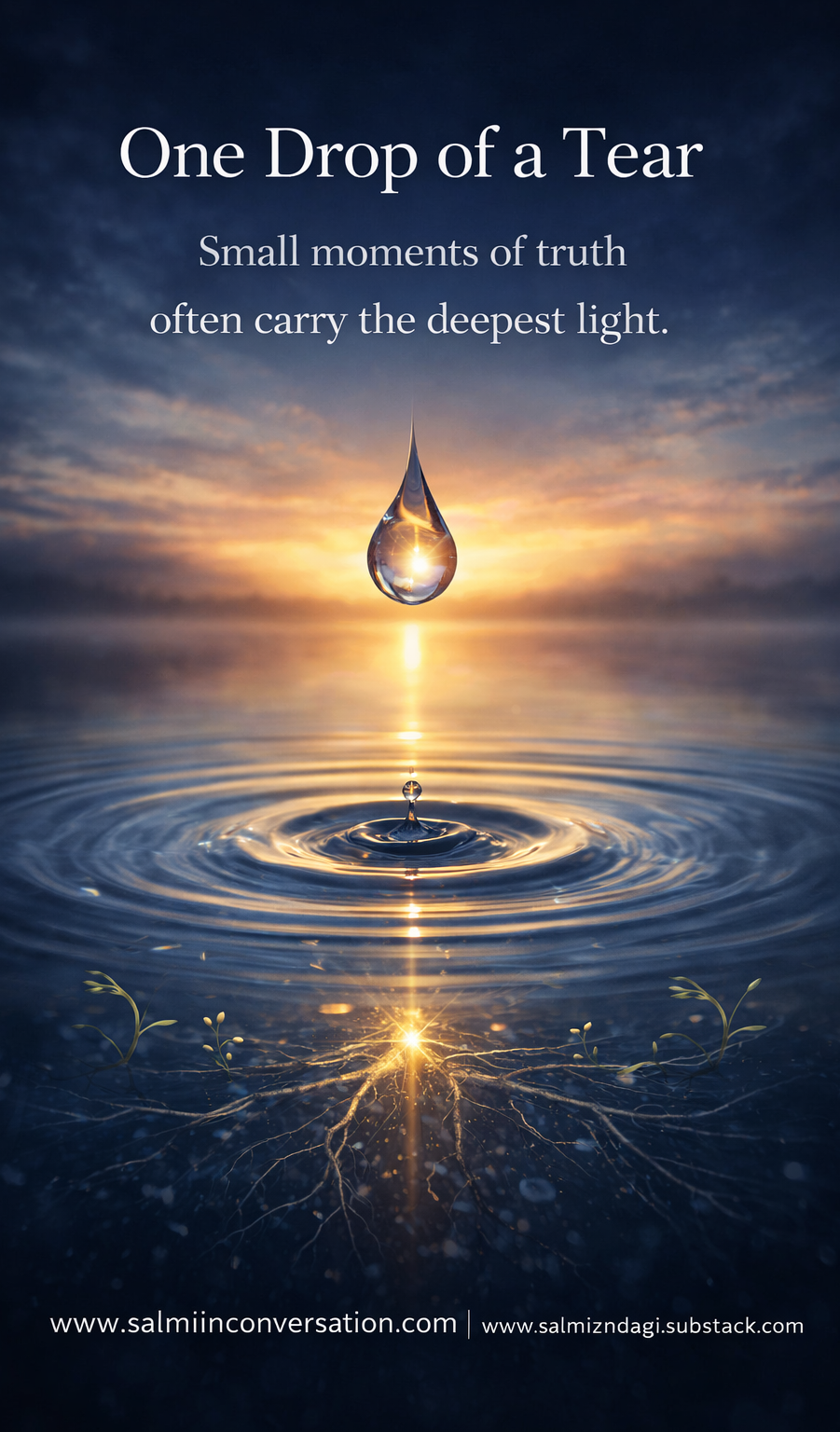
A tear is not drama.
It is truth in liquid form.
What We Were Taught to Hide
Many of us grew up with a familiar instruction:
Be strong.
Do not cry.
Do not show weakness.
These words were rarely spoken with cruelty. They were spoken with concern.
Parents wanted their children to survive a demanding world. Teachers believed discipline built character. Society admired composure.
So we learned a quiet skill.
We learned how to swallow tears.
Not because we felt less —
but because we were taught to show less.
Upbringing: Taleem (Education) and Tarbiyat (Formation - Upbringing)
Before scarcity, before migration, before the many chapters that life unfolds, something even more foundational shapes the human being.
Upbringing.
In many households and schools, taleem and tarbiyat walked hand in hand.
Education was not only about information.
It was about character.
Sometimes the roles even reversed for the best results.
A teacher shaped a student like a parent.
A parent became the first teacher of life.
In those years there was no scarcity of commitment to education, even if resources were modest.
Books were precious.
Time was disciplined.
Respect for learning was deeply embedded in both home and school.
What did not exist were the technological conveniences that surround us today.
There were no algorithms guiding decisions.
No artificial intelligence assisting daily tasks.
No digital clouds carrying the memory of the world.
Instead there was something quieter.
Patience.
Attention.
And the slow formation of character.
What Gen Z Was Taught to Question
The younger generation has grown up in a very different landscape.
A world of constant connectivity.
Constant sharing.
Constant reaction.
Constant exposure.
Every moment can be captured.
Every emotion can be commented on.
Yet strangely, this visibility has not always made vulnerability safer.
Many young people hesitate to show emotion.
Not because they lack depth —
but because sincerity can easily become spectacle.
When every feeling risks becoming content, authenticity can feel dangerous.
They did not become numb by choice.
They became numb by overload.
The Tear Has Two Parents: Joy and Grief
A tear does not belong exclusively to sadness.
Sometimes it belongs to gratitude.
Sometimes it appears when joy becomes too full to remain contained.
A parent watching a child graduate.
A grandparent holding a newborn.
A familiar song heard after many years.
A long-forgotten street suddenly appearing again.
A tear is not always sorrow.
Sometimes it is joy that could not stay inside.
Sometimes it is gratitude overflowing its quiet boundaries.
The tear carries both.
Joy and grief —
two parents of the same small drop.
The Arc of a Life Across Eras
From upbringing, life often moves through the realities of scarcity, where resilience quietly develops.
Then come the journeys of migration, where identity learns to adapt and expand.
Through education, horizons widen.
Through public service, responsibility toward society deepens.
Then arrives the sweeping wave of technology transformation, reshaping how the world communicates, works, learns and lives.
And now humanity stands at the threshold of the AI era, where algorithms, clouds, and intelligent systems begin to influence nearly every aspect of modern life.
Yet across all these transformations — from the disciplined classrooms of the past to the algorithmic platforms of today — the human heart has not forgotten its oldest language.
Sometimes it still speaks through just one drop of a tear.
When one looks back across a lifetime, the movement of eras becomes visible.
In one human life it is possible to witness an extraordinary arc of change.
The journey often begins with upbringing — taleem and tarbiyat — where households and schools work together to shape character.
And now humanity stands at the threshold of the AI era, where algorithms, intelligent systems, and digital clouds influence nearly every aspect of modern life.
Each stage brings its own language, its own anxieties, its own promises.
Civilizations evolve.
Technologies transform.
Generations reinterpret the world around them.
Yet across all these extraordinary changes — from scarcity to abundance, from handwritten pages to artificial intelligence — the human heart has not forgotten its oldest language.
Sometimes it still speaks through just one drop of a tear.
Returning to Roots
Recently, after many years away, I returned to places that shaped the earliest chapters of my life.
Nearly two decades had passed.
In that time life had carried me across continents, professions, responsibilities, and countless conversations with the world.
But roots carry their own quiet memory.
When I walked those familiar paths again, something unexpected happened.
The places did not simply bring back memories.
They brought back versions of myself.
The young student walking those streets.
The earlier dreams that had not yet encountered the complexity of the world.
And somewhere between recognition and gratitude, a single tear appeared.
Not because of sadness.
Because memory has weight.
And sometimes the heart acknowledges that weight in the simplest possible way.
The Strength of a Tear
We often misunderstand strength.
Strength is not the absence of tears.
Strength is the ability to feel deeply and remain steady.
A tear is the body releasing what language cannot fully explain.
It is the nervous system protecting the soul from hardening.
A tear is not collapse.
It is a release that prevents collapse.
Strength is not about how long you carry something.
It’s about knowing when it’s safe to put it down.
Why Some Do Not Let It Fall
Many people stop a tear before it falls.
Not because they are numb —
but because they are carrying weight.
Some of us have lived long enough to accumulate decades of responsibility, experience, survival, and exposure. We have crossed continents, cultures, systems, and expectations. We have learned how to stand — again and again — even when standing was costly.
I carried five decades of living with me.
Five continents of experience.
Successes, failures, lessons, silences — all quietly packed inside.
When I returned to my roots after eighteen years, it took only four days for that weight to surface.
Not as collapse.
As recognition.
Those roots did not merely welcome me back.
They absorbed what I had carried for half a lifetime.
The nourishment moved both ways.
What I had gathered across the world fed the soil I came from —
and that soil fed my soul with a strength I did not know I had been missing.
That single drop of tear did not fall from weakness.
It fell from the courage to finally set something down.
Many people don’t hold back tears because they don’t feel.
They hold back because they have carried too much — for too long — and learned how to keep moving.
So many carry their tears quietly.
Sometimes, allowing one tear to fall is not surrender.
It is integration.
Invisible.
Why Some No Longer Value Tears
Digital culture has created another complication.
Emotion is often filtered through performance.
There is another reason tears are often dismissed today.
Not suppressed — but devalued.
In a world where almost everything is shared, recorded, replayed, and judged, emotion itself has become suspect. Tears are quickly labeled: too much, cringe, attention-seeking, weak.
When feeling becomes performance, sincerity becomes fragile.
Many young people grow up watching emotions packaged for views — edited, amplified, consumed, forgotten. Over time, even genuine feeling begins to feel unsafe, or worse, irrelevant.
So some learn to distrust tears altogether.
Not because they don’t feel —
but because they don’t know which feelings are real anymore.
Yet a tear was never meant to impress.
It was never meant to persuade.
It was never meant to be seen.
A tear’s value is not in who notices it —
but in what it releases.
Online reactions move quickly:
Too dramatic.
Too sensitive.
Too much.
In such an environment, sincerity itself can begin to look suspicious.
When everything is performative, even honesty can appear exaggerated.
And so the tear — one of the oldest signals of human emotion — becomes misunderstood.
A Tear Is Not a Pause From Life — It Is Part of It
There is a misunderstanding that tears interrupt momentum.
That if you stop to feel, you will fall behind.
But life is not a race that punishes pause.
It is a rhythm that depends on it.
A single drop of tear does not slow life down.
It prevents life from hardening into something unrecognizable.
Feeling is not the opposite of progress.
It is what keeps progress human.
This matters — especially now — when so many are eager to “log on” to life, yet unsure how to enter it without armor.
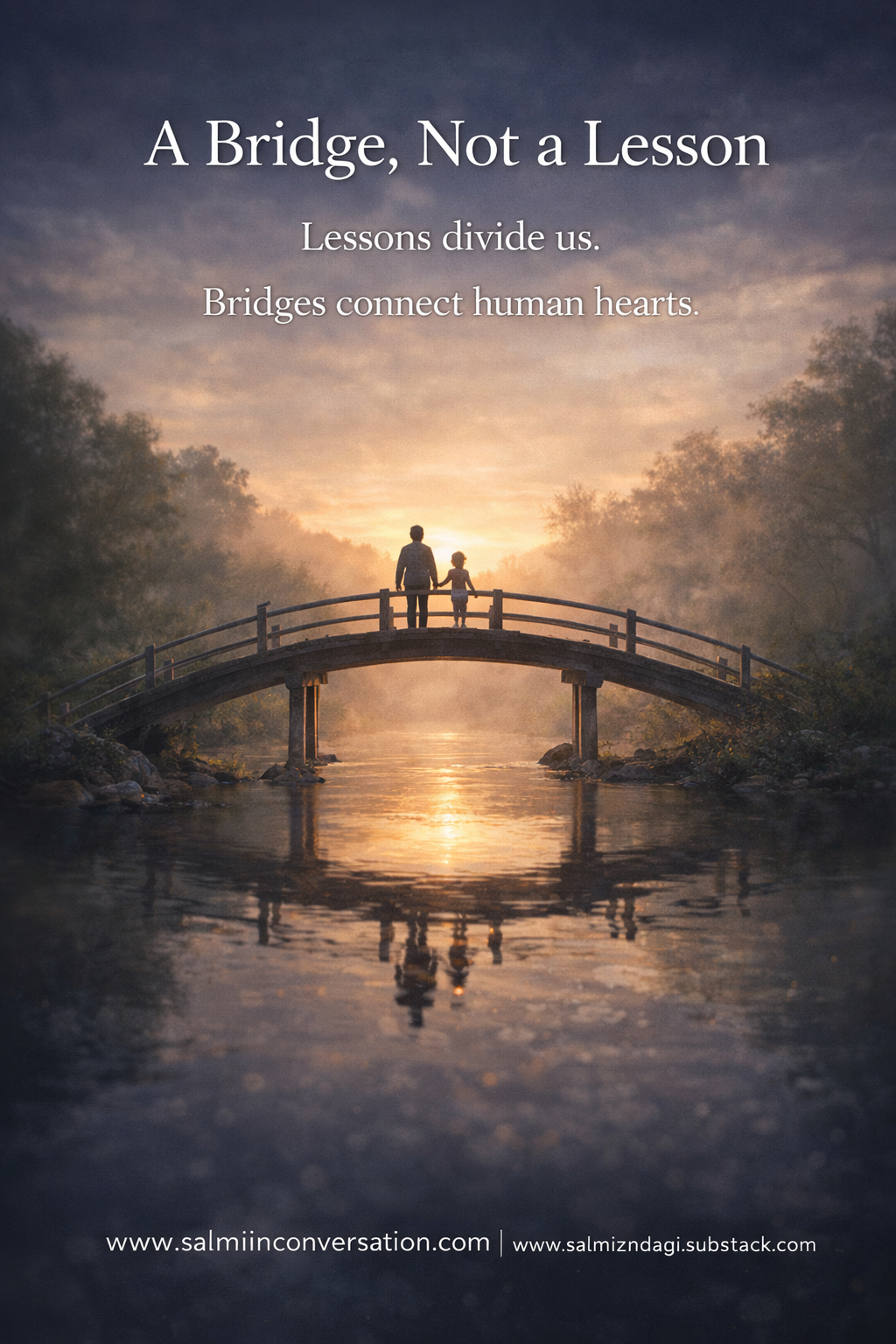
A Bridge, Not a Lesson
This is not an argument for more emotion.
Nor is it nostalgia for a softer past.
It is a reminder of something older than generations.
To those who learned to carry everything quietly:
Your tears do not erase your strength. They confirm your humanity.
To those still learning how to live in a loud, fast world:
Your tears do not disqualify you from resilience. They prepare you for it.
Before we analyzed ourselves, we felt.
Before we optimized life, we lived it.
A tear is not an obstacle to growth.
It is often the signal that growth is already happening.
To the One Standing at the Threshold of Life
If you are young and eager —
ready to step into a life that feels both exciting and overwhelming —
know this:
You do not need to be invincible to begin.
You do not need to have everything figured out.
You do not need to feel nothing to be strong.
Life does not ask you to be numb.
It asks you to be present.
And presence sometimes comes with moisture in the eyes.
That does not mean you are failing.
It means you are arriving.
A Shared Language Across Generations
Yet across generations, across cultures, across centuries, a tear still speaks a universal language.
From scarcity to the AI era, the human heart still speaks the same ancient language.
It requires no translation.
It is not ideology.
It is not performance.
It is biology meeting meaning.
Perhaps the bridge between generations is simpler than we imagine.
Elders can allow tears without policing them.
Youth can respect tears without mocking them.
Because a tear is not the loss of dignity.
It is a form of dignity.
Keep One Door Soft
The modern world is becoming faster, louder, and more efficient.
Productivity is measured.
Speed is rewarded.
Emotion is often compressed into silence.
Yet somewhere inside every human life, one door should remain soft.
Not permanently emotional.
Not endlessly sentimental.
Just capable of tenderness.
Because if you can still feel enough to shed just one drop of a tear, then somewhere inside you the human heart is still awake.
And a heart that can still feel is a heart that can still love.
Across scarcity and abundance.
Across migration and education.
Across public service, technology transformation, and the unfolding AI era.
Civilizations may transform in extraordinary ways.
But the smallest honest signal of the human heart remains unchanged.
Sometimes it appears quietly —
as just one drop of a tear.
Keep One Drop Sacred
The world moves faster each day — toward productivity, certainty, and noise.
In such a world, we do not need floods of emotion.
But we must protect the courage to allow just one drop.
One drop of tear that reminds us we are still capable of gratitude, memory, compassion, and love.
If that single drop can still fall,
the heart has not hardened.
And life — patient, unfinished, and quietly generous —
is still waiting to embrace us all.