When the Yellow Pages Waited for Our Touch
A reflective essay on how the Yellow Pages, telephone booths, railway stations, and human encounters shaped a five-decade journey — and what algorithms cannot replace in the age of instant search.

Searching, Serving, and the Human Journey Before Algorithms
Life in Conversation with Salmi
By Sulaiman Nasir (Salmi)
Leaving the Familiar Shore
Nearly five decades ago, I took my first real step outside the comfort of home.
It was not simply a physical departure.
It was a quiet crossing into the unknown.
I carried very little with me.
But what I did carry has stayed with me for a lifetime.
My mother’s love — generous beyond measure.
My father’s farsightedness — rooted in education, grace, and dignity.
The quiet strength of siblings whose affection expected nothing in return.
Those were my real possessions.
They became my compass.
Every journey begins with a small moment that appears ordinary at the time but later reveals itself as a turning point.
The day one leaves home for the first time carries such quiet gravity.
The familiar streets remain behind.
The rhythm of household life fades slowly into distance.
The voices that once filled the rooms now travel only through memory.
A young traveler steps forward with courage that is partly confidence and partly uncertainty.
And yet something invisible continues to accompany him.
Roots.
Not the roots of geography alone, but the roots of upbringing — the invisible architecture of values built by parents and family.
My mother taught generosity not through lectures but through example.
My father taught dignity not through instruction but through conduct.
From them I learned something that no book could ever teach:
that character is the only luggage that grows lighter the more it is carried.
The Early Geography of Life
In those early years of journeying, the world was learned not through screens but through places.
Railway stations were the gateways to possibility.
Bus stations and bus stops were classrooms of observation where human stories crossed paths without announcement.
Hospitals reminded us that hope and uncertainty often walk together.
Police stations represented the human search for order when life slipped beyond control.
And in the quiet halls of a morgue, one confronted the final truth that every traveler eventually reaches the last station.
These places were not merely physical structures.
They were stations of life itself.
At railway platforms strangers helped one another lift luggage.
At bus stops people exchanged directions and advice.
In hospital waiting rooms families held each other in silent reassurance.
Human beings noticed one another because the rhythm of life still allowed time for noticing.
The Appearance of a Quiet Companion
Somewhere along that journey another companion appeared.
It was not alive.
It had no voice.
Yet it carried the livelihoods and coordinates of entire communities.
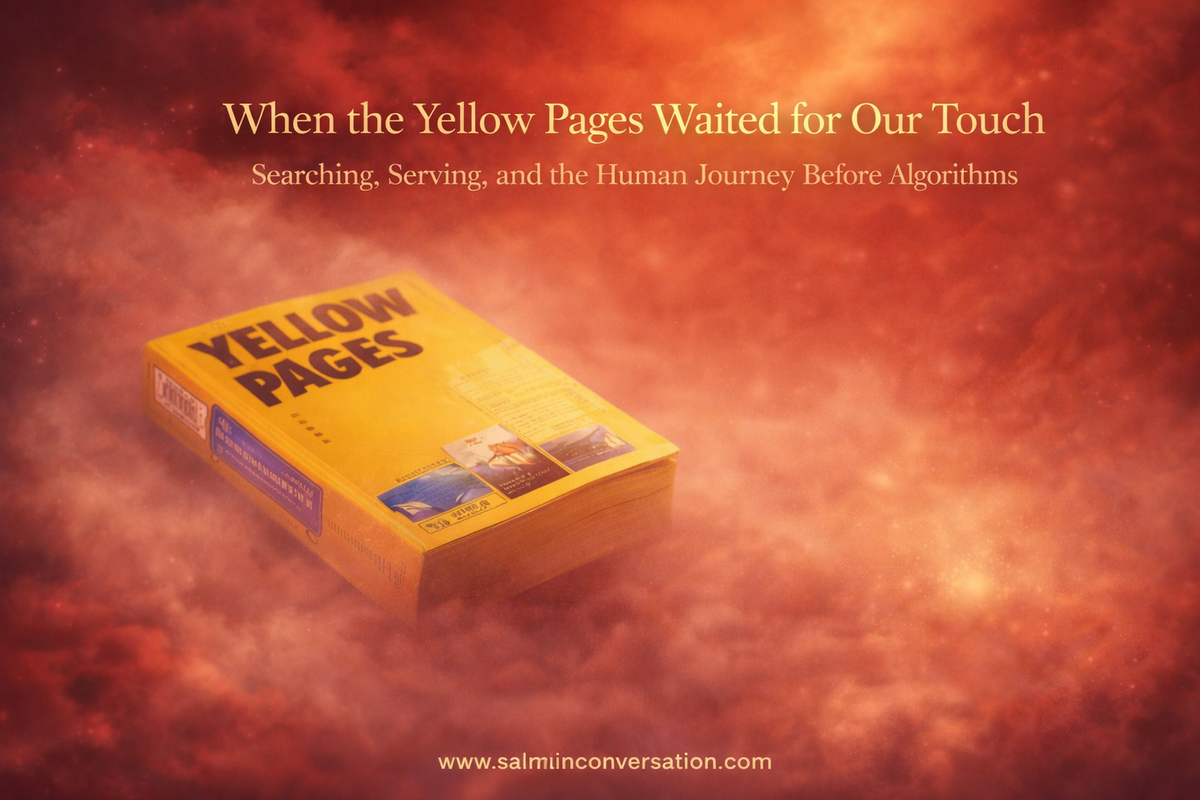
The Yellow Pages.
A thick book with delicate pages filled with names, numbers, and addresses.
If you needed a doctor, you opened it.
If your car refused to start, you searched its pages for a mechanic.
If a door broke or a pipe leaked, somewhere within those columns of print lived the number of someone who could help.
The Yellow Pages did something simple but profound.
It connected strangers.

Touch Was Part of the Search
Finding someone through the Yellow Pages required patience.
You touched the pages.
You turned them slowly.
Your eyes traveled through rows of names until the right one appeared.
Sometimes the page you needed had already been folded by someone else.
Sometimes the corner was torn.
Sometimes someone had circled a number in pen.
Those marks were small traces of human urgency left behind by previous seekers.
Yet the book never resisted.
No matter how roughly it had been handled, it waited quietly for the next touch.
The Telephone Booth and the Courage to Ask
The Yellow Pages were rarely used alone.
They almost always lived beside another quiet object that once stood at the center of human communication — the telephone.
Often it was not even your own telephone.
In many cities the call had to be made from a public telephone booth.
A small glass enclosure on a street corner.
Sometimes near a bus station.
Sometimes inside a railway terminal.
Sometimes outside a hospital where worried families waited for news.
The ritual was simple.
You opened the Yellow Pages.
You found the number you needed.
You stepped into the booth.
You dropped coins into the slot.
And then something very human happened.
You heard a voice.
Not a machine.
Not a menu of automated options.
Not a digital assistant.
A human voice.
“Hello.”
Looking back now, those moments required something we rarely speak about today.
The courage to ask for help.
Trust Before Ratings
In those days, when you called a number from the Yellow Pages, you had no ratings.
No five-star reviews.
No comment sections.
No algorithm deciding which service provider deserved your attention.
You simply chose a name and dialed the number.
Trust was not calculated.
It was practiced.
Two strangers briefly sharing a moment of human effort.
The Invisible Work of Ordinary People
What the Yellow Pages quietly revealed was the vast network of ordinary people holding society together.
Mechanics who fixed engines before dawn.
Electricians who arrived in the middle of the night when lights failed.
Doctors who answered emergency calls without hesitation.
Carpenters, plumbers, teachers, tailors, small shop owners — people whose work rarely appeared in headlines but whose contributions shaped everyday life.
Each name printed in those pages represented a livelihood.
A family.
A story.
The Yellow Pages were not merely a directory of services.
They were a directory of human effort.
Stations of Waiting
As my own journey unfolded across continents, those places of waiting continued to appear.
Railway stations.
Bus stops.
Hospital corridors.
Police stations.
And the quiet dignity of a morgue.
In each place something profound occurred.
People waited.
And while waiting, they became aware of one another.
When Coordinates Entered the Clouds
Today the world has changed.
Names, numbers, and locations no longer live in thick books on dusty shelves.
They float through invisible networks.
Our questions travel through clouds of algorithms.
Answers arrive before we even finish asking.
The speed is astonishing.
Yet something subtle has changed.
We no longer touch the world when we search it.
The First Night Away From Home
Every long journey carries a moment that quietly marks the beginning of adulthood.
For many travelers, it arrives on the first night away from home.
The excitement of departure slowly settles into silence.
The room is unfamiliar.
The sounds are different.
Yet even in that quiet moment of distance, the roots remain close.
A mother’s generosity continues to guide you.
A father’s wisdom quietly shapes your decisions.
Those first nights away from home are not easy.
But they are often the nights when a person first understands the strength placed inside them by family.
What Algorithms Cannot Replace
The world today is more connected than any generation before.
Algorithms deliver answers instantly.
But even the most sophisticated technology cannot replace certain human qualities.
Algorithms can provide information.
But they cannot provide wisdom.
They cannot replicate compassion.
They cannot replicate the quiet dignity of a parent guiding a child or the reassurance of a stranger helping another traveler.
Character still grows slowly.
The Enduring Directory of Human Life
Looking back across decades of journey, I sometimes think about the many directories that have guided human life.
Some were printed on paper.
Some now float invisibly in digital clouds.
But the most important directory has always been human.
It is written in the values we inherit from our parents.
It is written in the kindness we extend to strangers.
The Day the Yellow Pages Disappeared
One day, without announcement, the Yellow Pages were simply no longer there.
No ceremony marked their departure.
No farewell message appeared.
They had quietly stepped aside as the world moved into the age of digital searching.
Perhaps that is the way many humble servants of society leave.
Without applause.
Without recognition.
Yet the memory of those pages remains.
Not because of the numbers they contained.
But because of the human rhythm they represented.
Turning pages.
Searching slowly.
Trusting strangers.
Listening to human voices.
A Final Reflection
The Yellow Pages may have disappeared from our shelves.
But their lesson remains.
Behind every number is a human story.
Behind every service is a livelihood.
Behind every search is a person hoping to find another person.
Perhaps that is the real directory of life.
Not the one printed on paper.
Not the one floating in digital clouds.
But the one written quietly in the relationships that connect human beings to one another.
— Salmi
Life in Conversation with Salmi
www.salmizindagi@substack.com