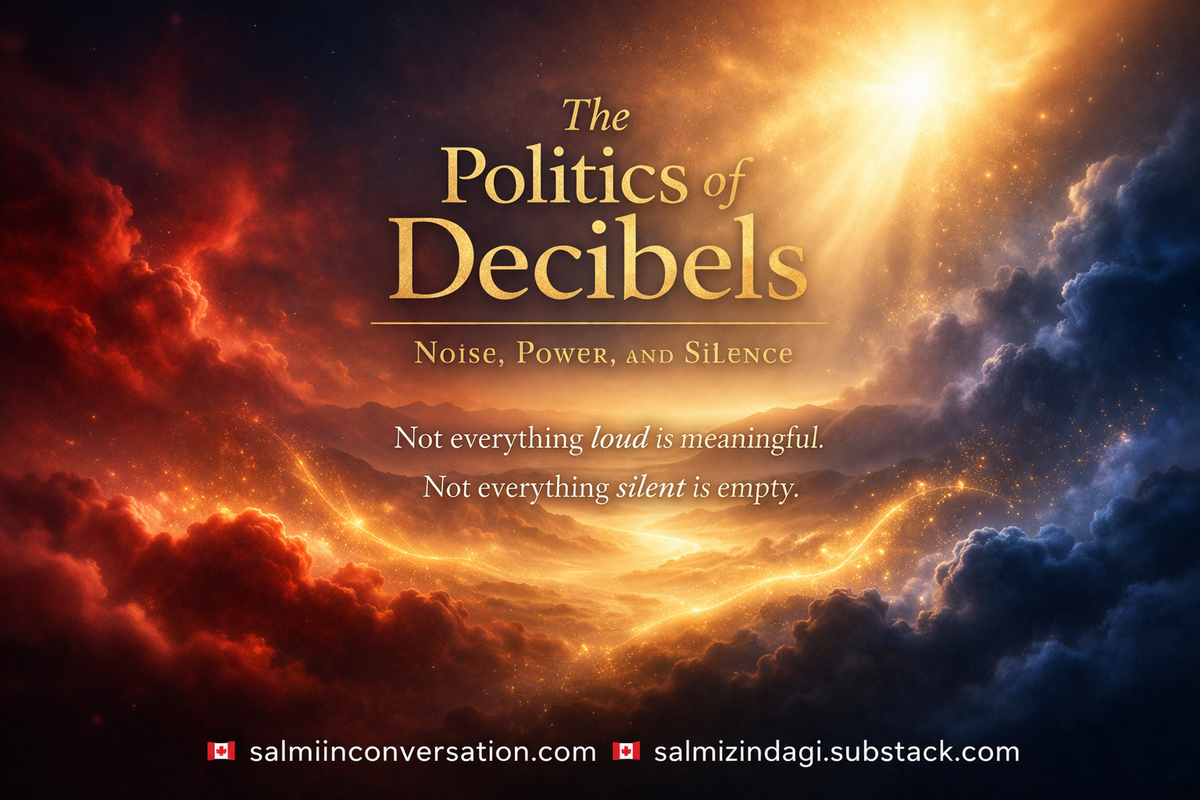
The Politics of Decibels — Noise, Power, and Silence
Life, Legitimacy, and the Unequal Distribution of Voice

By Sulaiman Nasir (Salmi)
We are no longer living in an age where truth rises on its own merit.
We are living in an age where volume determines visibility—and visibility is mistaken for truth.
The loudest voice is no longer questioned.
It is followed.
And somewhere between noise and knowledge, something essential is being lost.
The Age of Amplification — When Being Heard Replaced Being Worth Hearing
There was a time when voice required presence.
To be heard, one had to arrive—physically, intellectually, and morally.
Today, voice requires something else: amplification.
We live not merely in an information age, but in an age of decibels—
where visibility is engineered, attention is monetized,
and volume often precedes value.
The question is no longer what is being said,
but how loudly—and how widely—it is being heard.
This subtle shift has redefined the architecture of public discourse.
When Volume Replaces Value — The Quiet Collapse of Meaning
A decibel, in its original form, measures intensity—not meaning.
Yet in our political and social ecosystems, intensity has quietly replaced substance:
Repetition is mistaken for credibility.
Emotion is mistaken for evidence.
Visibility is mistaken for legitimacy.
The result is a distortion:
The loudest argument appears strongest,
even when it is the least examined.
This is not merely a communication problem.
It is an epistemological crisis—
a crisis of how we come to know what we think we know.
Power and the Unequal Distribution of Voice — Who Gets Heard, and Who Does Not
Decibels are not evenly distributed.
They are shaped by power—economic, institutional, and technological.
Those with resources:
own platforms
influence narratives
command attention
Those without:
rely on fragments of visibility
struggle to be heard beyond their immediate realities
This is not silence by choice.
It is silencing by structure.
And in such a world, inequality is not only material—
it is auditory.
Some voices echo across continents.
Others never leave the room.
The Algorithmic Amplifier — When Machines Decide What Matters
The digital age promised democratization of voice.
In many ways, it delivered.
But it also introduced a new arbiter: the algorithm.
Algorithms do not measure truth.
They measure engagement.
And engagement often favors:
outrage over reflection
speed over depth
certainty over inquiry
What rises is not always what matters—
but what moves fastest through the circuitry of attention.
Thus, the decibel is no longer human.
It is computational.
Silence as Strength — The Most Misunderstood Power
In such a landscape, silence is often misunderstood.
It is seen as:
weakness
disengagement
irrelevance
But silence, when chosen consciously, is none of these.
It is:
space for thought
resistance to noise
protection of integrity
Silence does not compete.
It cultivates.
And often, what emerges from silence
outlives what was shouted.
Toward a New Measure of Value — Reclaiming What Matters
If decibels cannot be our measure, what can?
Perhaps we must return to older, quieter metrics:
Depth over immediacy
Consistency over visibility
Integrity over influence
Inquiry over assertion
A society that cannot distinguish between noise and knowledge
risks losing both.
A Personal Reckoning — The Responsibility of Participation
Each of us participates in this ecosystem.
We amplify.
We react.
We contribute to the very decibel economy we question.
The challenge, then, is not external alone.
It is deeply personal:
When do we choose to speak?
When do we choose to listen?
And when do we choose not to add to the noise?
Because restraint, too, is a form of contribution.
The Quiet Future — Beyond the Tyranny of Volume
The loudest voices will always shape the moment.
But history—
and humanity—
have rarely been shaped by noise alone.
They have been shaped by those who could:
think beyond the immediate
speak without shouting
remain grounded when the world was not
Perhaps the future will not belong
to those who mastered the highest decibels—
but to those who understood
when not to use them.
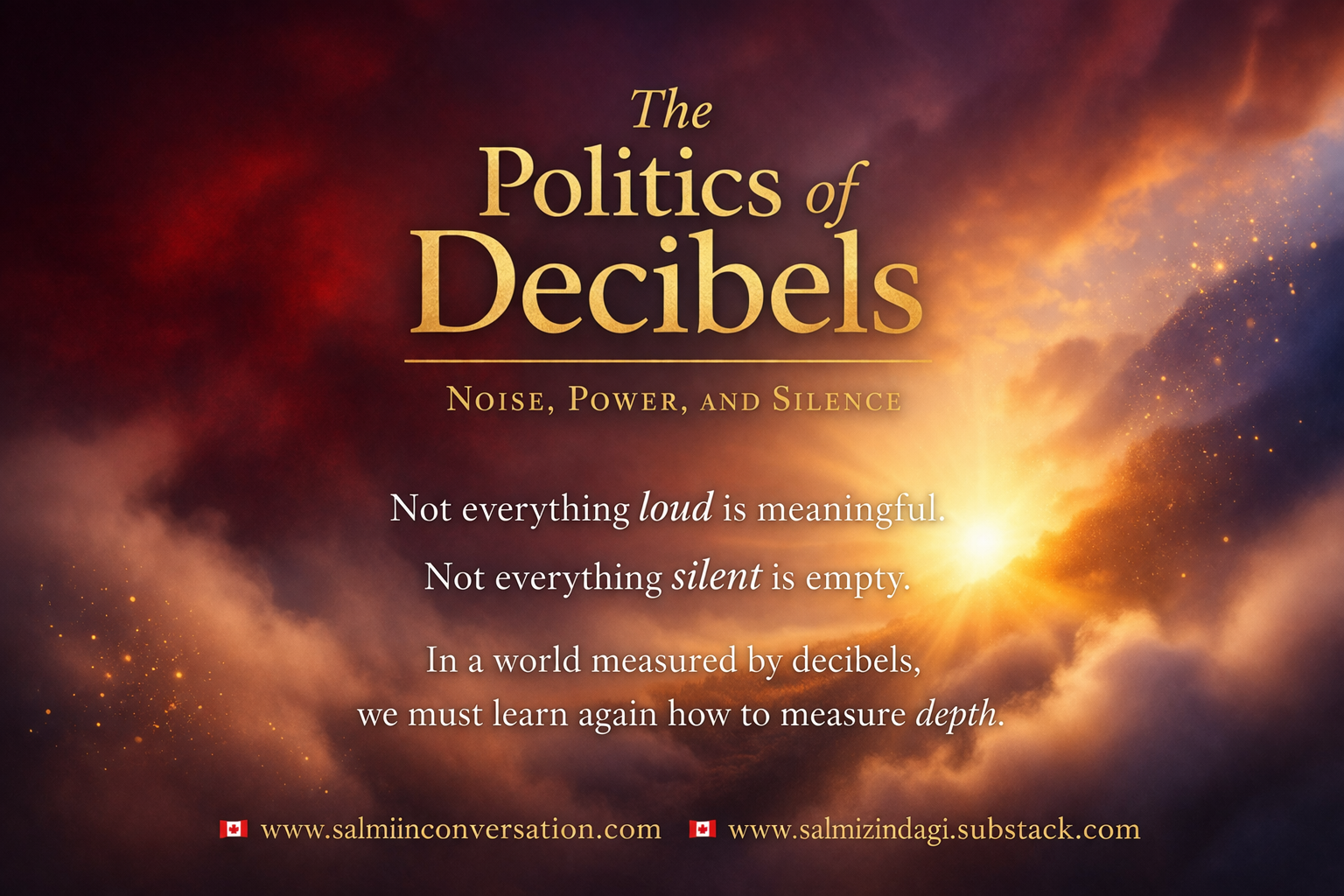
In a world measured by decibels,
we must learn again how to measure depth.
Because not everything that is heard is understood.
And not everything that matters needs to be loud.
Continue Reading
If this reflection resonates, you may find depth in:
- The Invisible Office — Work, Relationships, and Meaning in an AI-Driven World
- The Mathematics of Meaning — While Maintaining Momentum
- Between Minimum and Maximum — Who Guards the Middle
Knowledge and Information — and In Between
When knowing begins, but understanding has yet to arrive.
© 2026 Sulaiman Nasir | Life in Conversation with Salmi
All original writing, narration, and visual concepts remain the intellectual property of the author. Unauthorized reproduction, adaptation, distribution, or use of this work is prohibited.
© 2026 Sulaiman Nasir | Life in Conversation with Salmi
All original writing, narration, and visual concepts remain the intellectual property of the author. Unauthorized reproduction, adaptation, distribution, or use of this work is prohibited.
🇨🇦 www.salmiinconversation.com
🇨🇦 https://salmizindagi.substack.com