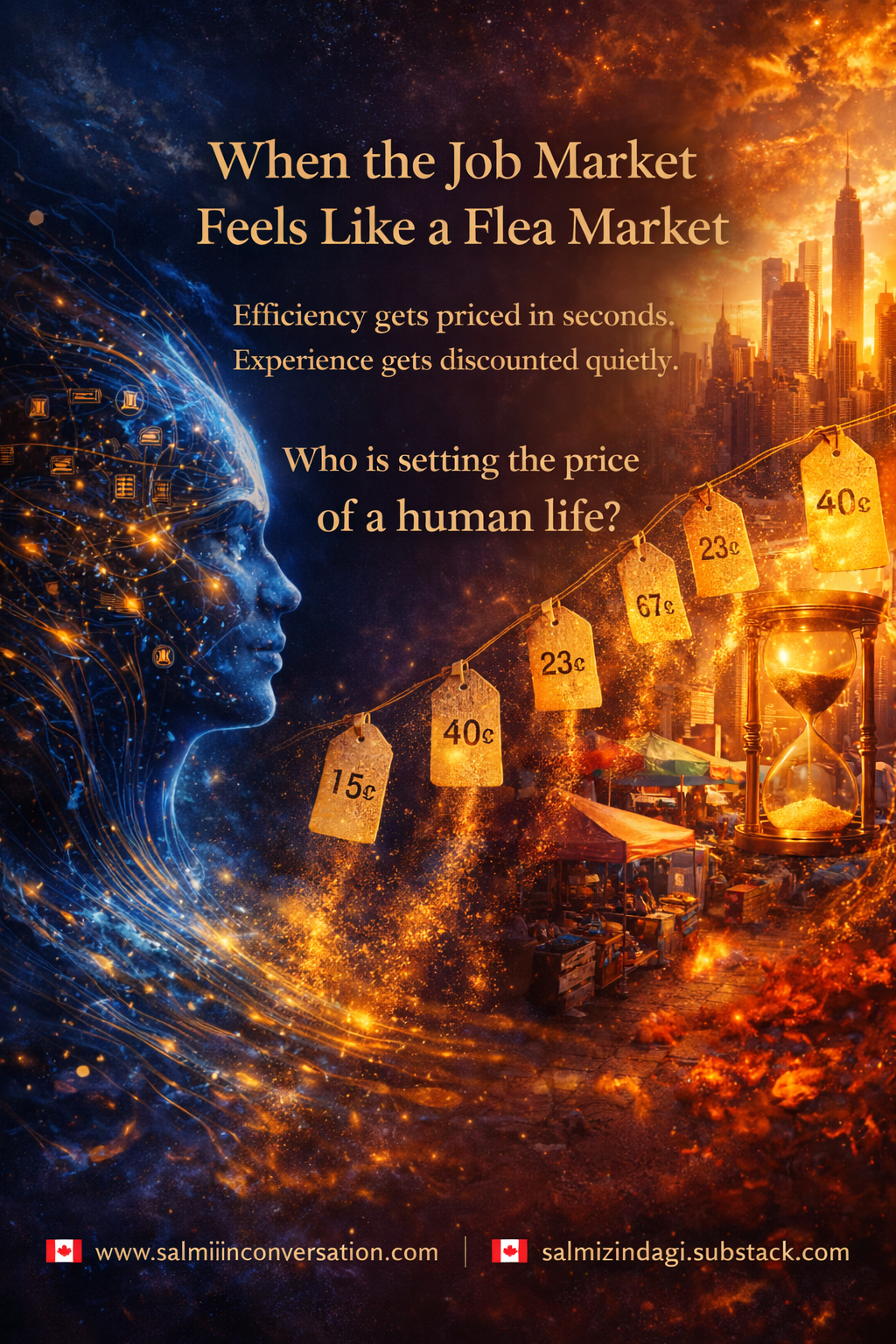
When the Job Market Feels Like a Flea Market
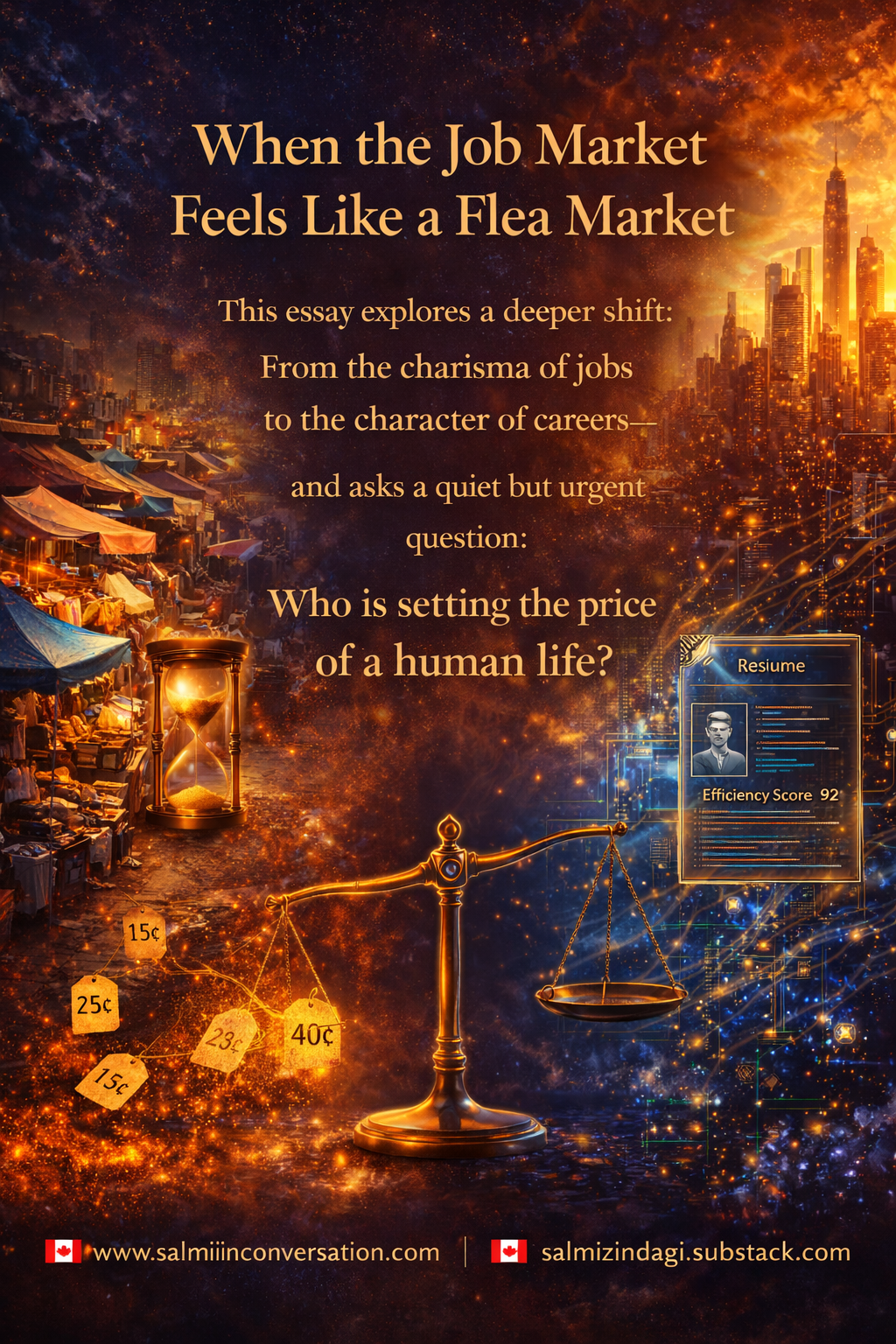
When markets begin pricing efficiency faster than they recognize experience, the job market starts to resemble a flea market. This essay explores the deeper shift from the charisma of jobs to the character of careers — and asks a quiet but urgent question: who is setting the price of a human life?

By: Sulaiman Nasir (Salmi)
From the Charisma of Jobs to the Character of Careers
Who Is Setting the Price of a Human Life?
The modern job market increasingly resembles something unexpected — a flea market.
Crowded.
Noisy.
Constantly bargaining.
Prices shifting from moment to moment.
And somewhere within this movement, a quiet question begins to surface.
Who is doing the valuation?
Who is measuring the worth of human effort against the weight of algorithms, automation, and relentless cost optimization?
Who decides what decades of accumulated learning are worth when the rules of the market are rewritten every quarter?
And perhaps the most uncomfortable question of all:
Are we still human participants in this system —
or are we becoming priced entities within it?
From Dignified Exchange to Negotiated Existence
Once upon a time, the job market resembled something closer to a dignified exchange.
Skill met demand.
Effort met opportunity.
Value was measured not merely in wages — but in contribution.
There was structure.
There was continuity.
There was recognition.
Today, that structure feels loosened.
The same market now resembles a sprawling space of constant negotiation — where stability is uncertain and permanence feels temporary.
This is not just a shift in economics.
It is a shift in meaning.
The Narrative Beneath the System
Every era tells itself a story.
Ours tells us:
Technology will create opportunity.
Globalization will expand reach.
Digital platforms will democratize work.
And in many ways, this is true.
But beneath that story, another one quietly unfolds.
Opportunities appear — and disappear.
Work arrives — and fragments.
Stability fades — and recalculates itself continuously.
And then, almost invisibly, the system begins to whisper:
Adapt faster.
Work harder.
Stay cheaper.
When did survival become optimization?
The Illusion That Feels Like Freedom
Let’s be fair.
This era has opened doors no generation has seen before.
A creator can reach the world.
A developer can work across borders.
A voice can travel without permission.
Flexibility exists.
Access exists.
Possibility exists.
And Gen Z — remarkably — is adapting with speed, creativity, and courage.
But here is the deeper question:
When everything becomes possible…
what remains stable?
Because possibility without structure can quietly become pressure.
The Cost We Don’t Measure
Every system carries a visible layer — and a hidden one.
The visible layer shows opportunity.
The hidden layer carries cost.
Stability weakens.
Security becomes conditional.
Continuity becomes uncertain.
And slowly, something more subtle begins to happen.
People begin to look like products.
Rated.
Ranked.
Optimized.
Replaced.
When did capability become inventory?
Freedom without safety becomes exposure.
Work without belonging becomes transaction.
And identity — once shaped through contribution — begins to drift.
The Question That Changes Everything
At this point, the conversation must shift.
Not about jobs.
But about meaning.
Should Gen Z simply adapt to the charisma of the job market?
Or should they seek the character of a careers market?
Because the difference is not small.
A job is a transaction.
A career is a trajectory.
A job pays.
A career builds.
A job is immediate.
A career accumulates.
The job market excites.
The careers market sustains.
And a life cannot be built on excitement alone.
From Charisma to Character
Charisma attracts attention.
Character builds trust.
The modern job market thrives on charisma — speed, visibility, responsiveness.
But careers are built differently.
Slowly.
Quietly.
Deliberately.
Through mentorship.
Through continuity.
Through accumulated experience.
A careers market does something the job market cannot.
It remembers.
The Migration We Must Make
Jobs are not the problem.
They are the entry point.
But they cannot be the destination.
Gen Z will move through gigs, roles, projects, transitions.
That is the reality of this era.
But something deeper must follow.
From transaction → transformation
From gig → growth
From charisma → character
Because speed may move a life forward…
…but only purpose can hold it together.
If the Market Learned to Care
Now imagine something different.
Imagine if markets stopped trading people…
…and started developing them.
Imagine organizations that invest in human potential the way they invest in capital.
Imagine leadership that measures growth in decades — not quarters.
Imagine a system where:
People are not resources.
They are repositories of meaning.
If traders became caretakers…
…the entire market would change its character.
We Are Only the Bridge
There is a quiet truth we must accept.
We are not the destination.
We are the bridge.
The question is not what we achieved.
The question is:
What are we passing forward?
A marketplace of transactions?
Or a marketplace of development?
Let Gen Z cross with:
Grace.
Dignity.
Clarity.
Because they are not entering a workforce.
They are inheriting a system.
What Will They Inherit?
If we pass on:
Exhaustion…
Precarity…
Endless negotiation…
Then we leave them navigating instability.
But if we pass on:
Wisdom…
Continuity…
Human dignity…
Then something else becomes possible.
Not immediately.
But gradually.
They may transform what we handed over.
The Choice That Remains
This is no longer just an economic discussion.
It is moral.
It is cultural.
It is civilizational.
The old trade routes carried goods…
…but also ideas.
The modern economy can do the same.
The question has not disappeared.
It has only become quieter.
Will we pass down chaos?
Or will we pass down care?
And Perhaps… One More Question
The future of work will not be decided by algorithms alone.
It will be shaped by what we choose to value.
In systems.
In institutions.
In each other.
And perhaps the real question is still waiting — just beneath everything we have built:
Not what the market will become…
…but
what kind of human beings
it is quietly shaping us to be.
© 2026 Sulaiman Nasir | Life in Conversation with Salmi
All original writing, narration, and visual concepts remain the intellectual property of the author. Unauthorized reproduction, adaptation, distribution, or use of this work is prohibited.
🇨🇦 www.salmiinconversation.com
🇨🇦 https://salmizindagi.substack.com