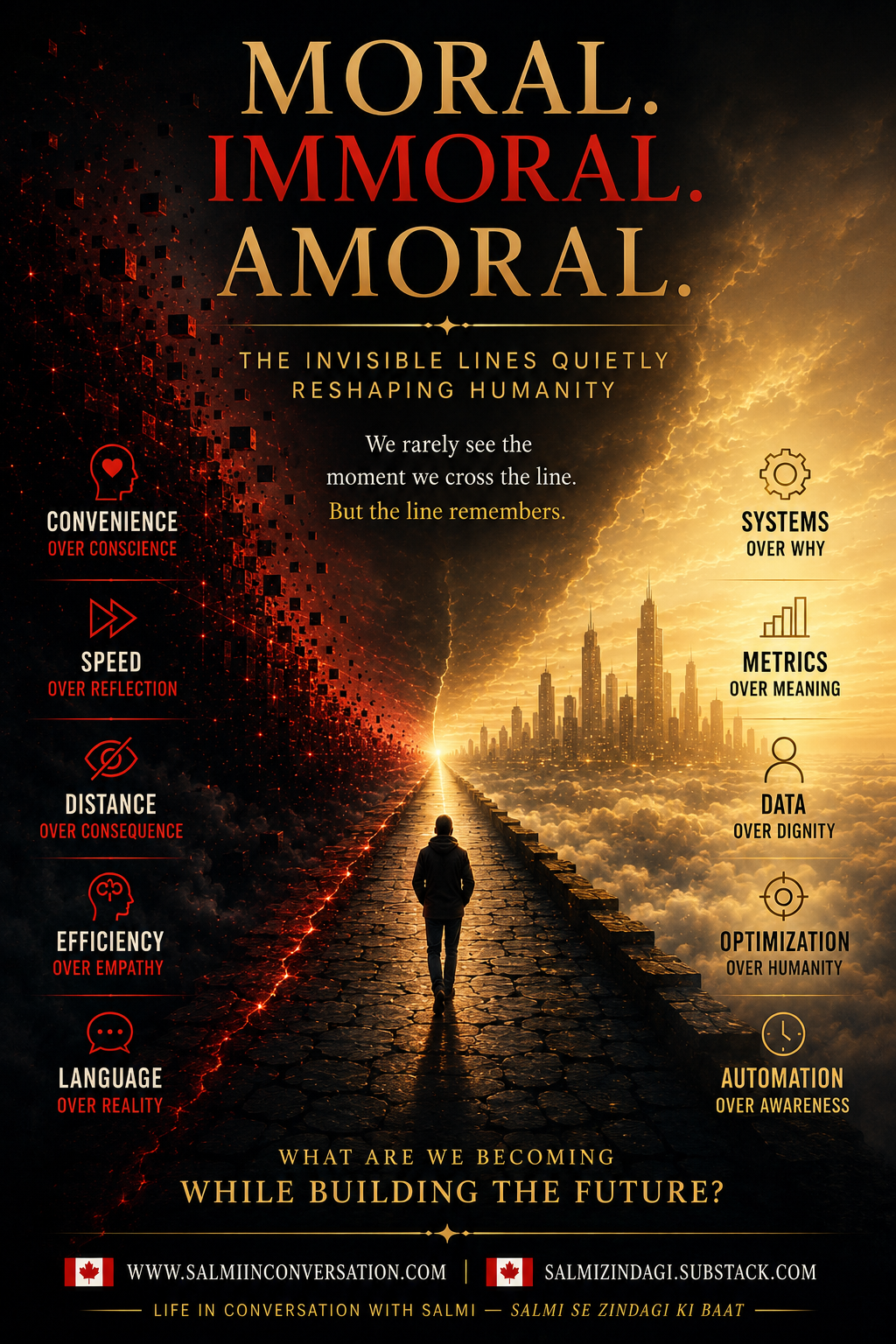
Moral. Immoral. Amoral.
Civilizations rarely collapse in a single moment of visible destruction. The Invisible Lines Quietly Reshaping Humanity

By Sulaiman Nasir (Salmi)
We often recognize what is moral.
We quickly condemn what is immoral.
But the most dangerous territory may be something else entirely:
the growing comfort of becoming amoral.
Not evil.
Not cruel.
Simply disconnected.
More often, they drift quietly through invisible compromises — where convenience begins replacing conscience, speed overtakes reflection, and systems stop asking why while continuing to optimize how.
This reflection explores the fragile and increasingly blurred intersections between the moral, the immoral, and the amoral in an age shaped by algorithms, efficiency, emotional exhaustion, and normalization.
Not as a judgment against technology or humanity — but as a deeper inquiry into what we may slowly be becoming while building the future around us.
Civilizations rarely announce the moment they begin crossing invisible lines.
The transition is usually gradual — hidden inside convenience, speed, ambition, fear, efficiency, exhaustion, adaptation, and normalization.
What once troubled conscience slowly becomes accepted behavior.
What once demanded reflection becomes automated reaction.
What once felt deeply human becomes operational, measurable, scalable, optimized.
And somewhere between the moral, the immoral, and the amoral, humanity begins negotiating with itself — often without realizing the price of the negotiation.
This is not merely a question of right and wrong.
Human history has always struggled with morality.
But our era presents something different:
not only the conflict between moral and immoral —
but the silent expansion of the amoral.
A space where systems no longer ask:
“Is this right?”
Only:
“Does this work?”
“Does this scale?”
“Does this trend?”
“Does this monetize?”
“Does this win?”
And perhaps that is where the invisible lines begin.
The Line Was Never Completely Visible
The boundary between moral and immoral has never been a painted line on the ground.
It has always lived inside conscience, culture, circumstance, survival, power, fear, wisdom, and human vulnerability.
But the line between immoral and amoral is even more difficult to detect.
Immorality may knowingly cross the line.
Amorality slowly removes the line itself.
Not through dramatic rebellion —
but through indifference.
And indifference, when scaled through systems, technologies, institutions, algorithms, bureaucracy, economics, and social behavior, can quietly reshape civilizations without ever appearing openly hostile.
That is why modern humanity often feels unsettled without fully understanding why.
We are not only confronting wrongdoing.
We are confronting environments where moral reflection itself is slowly disappearing from decision-making processes.
When Conscience Becomes Negotiable
Most civilizations do not collapse because every individual suddenly becomes immoral.
They drift when conscience becomes flexible.
When convenience begins replacing reflection.
When exhaustion weakens resistance.
When adaptation becomes survival.
When people quietly tell themselves:
- “This is just how the world works now.”
- “Everyone does it.”
- “There is no other way.”
- “At least I am surviving.”
- “It’s only data.”
- “It’s only business.”
The compromise rarely feels catastrophic in the beginning.
That is what makes it dangerous.
Humanity rarely leaps into moral collapse.
It drifts there — one normalized compromise at a time.
Convenience vs Conscience
Modern civilization rewards speed.
Instant responses.
Instant validation.
Instant outrage.
Instant visibility.
Instant consumption.
Convenience has become one of the defining emotional currencies of contemporary life.
But convenience often asks conscience to remain quiet.
Not because people are inherently cruel —
but because reflection slows momentum.
And systems built around momentum do not naturally reward pause, doubt, humility, or moral friction.
The question quietly emerging beneath modern life may therefore be:
At what point does convenience stop serving humanity —
and humanity begin serving convenience?
Intelligence Without Moral Friction
Human intelligence is accelerating at extraordinary speed.
Artificial intelligence.
Predictive systems.
Behavioral modeling.
Algorithmic optimization.
Automated decision-making.
But intelligence alone has never guaranteed wisdom.
An algorithm does not need hatred to create harm.
Indifference is often enough.
This may become one of the defining paradoxes of our age:
systems becoming more intelligent while human reflection becomes more fragmented.
Capability is advancing faster than conscience.
And when intelligence grows without moral friction, humanity begins entering unfamiliar territory —
not always immoral,
but increasingly amoral.
The Quiet Rise of the Amoral
Perhaps the greatest transformation of the modern era is not open evil.
Humanity has always recognized obvious cruelty.
The deeper challenge today is normalization without reflection.
Systems that do not hate humanity —
but simply do not pause to protect it.
Structures that optimize engagement while exhausting attention.
Platforms that amplify outrage because outrage sustains visibility.
Economic systems that reward acceleration while emotional exhaustion quietly spreads underneath.
Nothing appears openly monstrous.
Yet something essential slowly weakens:
human sensitivity itself.
And perhaps that is why many people today feel surrounded by noise yet starved for meaning.
Distance From Consequence
Historically, human actions often carried visible proximity to consequence.
Communities were smaller.
Relationships were direct.
Accountability was personal.
Now consequences travel invisibly across continents.
A decision made in one room may emotionally affect millions elsewhere who remain unseen by those making the decision.
Distance weakens emotional gravity.
The farther humanity becomes from the human impact of its systems, the easier it becomes to cross invisible lines unknowingly.
And perhaps this is one of the most dangerous conditions of all:
the ability to affect humanity without feeling humanity.
Language That Sanitizes Reality
Civilizations do not only cross moral lines through action.
They often cross them through language first.
Words can soften conscience.
- “Collateral damage”
- “User engagement”
- “Human resources”
- “Behavioral targeting”
- “Content optimization”
- “Efficiency restructuring”
Language can transform human experience into operational terminology.
And when vocabulary loses emotional weight, conscience slowly loses emotional proximity.
The line does not disappear immediately.
It simply becomes harder to feel.
When Speed Becomes Authority
Modern civilization increasingly equates speed with intelligence.
The faster the response,
the greater the perceived relevance.
But wisdom has rarely emerged from acceleration alone.
Wisdom traditionally required:
- contemplation,
- uncertainty,
- listening,
- contradiction,
- emotional maturity,
- and the humility to remain unfinished.
Speed compresses reflection.
And when reflection disappears, reaction begins impersonating understanding.
Perhaps this is why modern societies appear simultaneously hyper-informed and deeply uncertain.
Information has expanded.
Inner stillness has not.
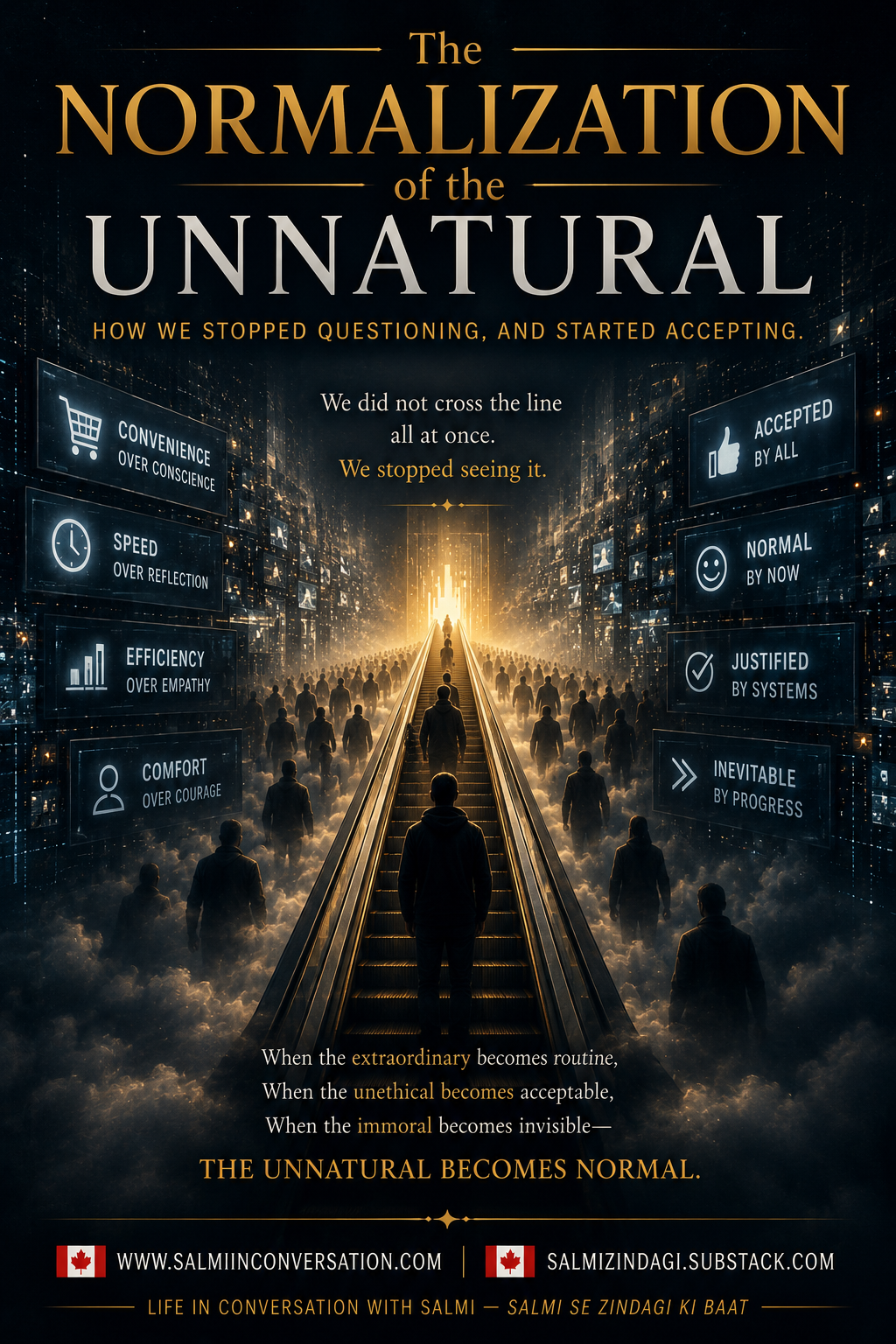
The Normalization of the Unnatural
One of the most invisible moral shifts occurs when repetition transforms abnormality into ordinary life.
Noise becomes culture.
Distraction becomes identity.
Performance becomes authenticity.
Metrics become meaning.
And eventually humanity stops asking:
Should this exist?
Only:
How do we succeed within it?
That may be one of the defining psychological transitions of our era.
Not the destruction of morality —
but the gradual adaptation to environments where moral questioning itself feels inefficient.
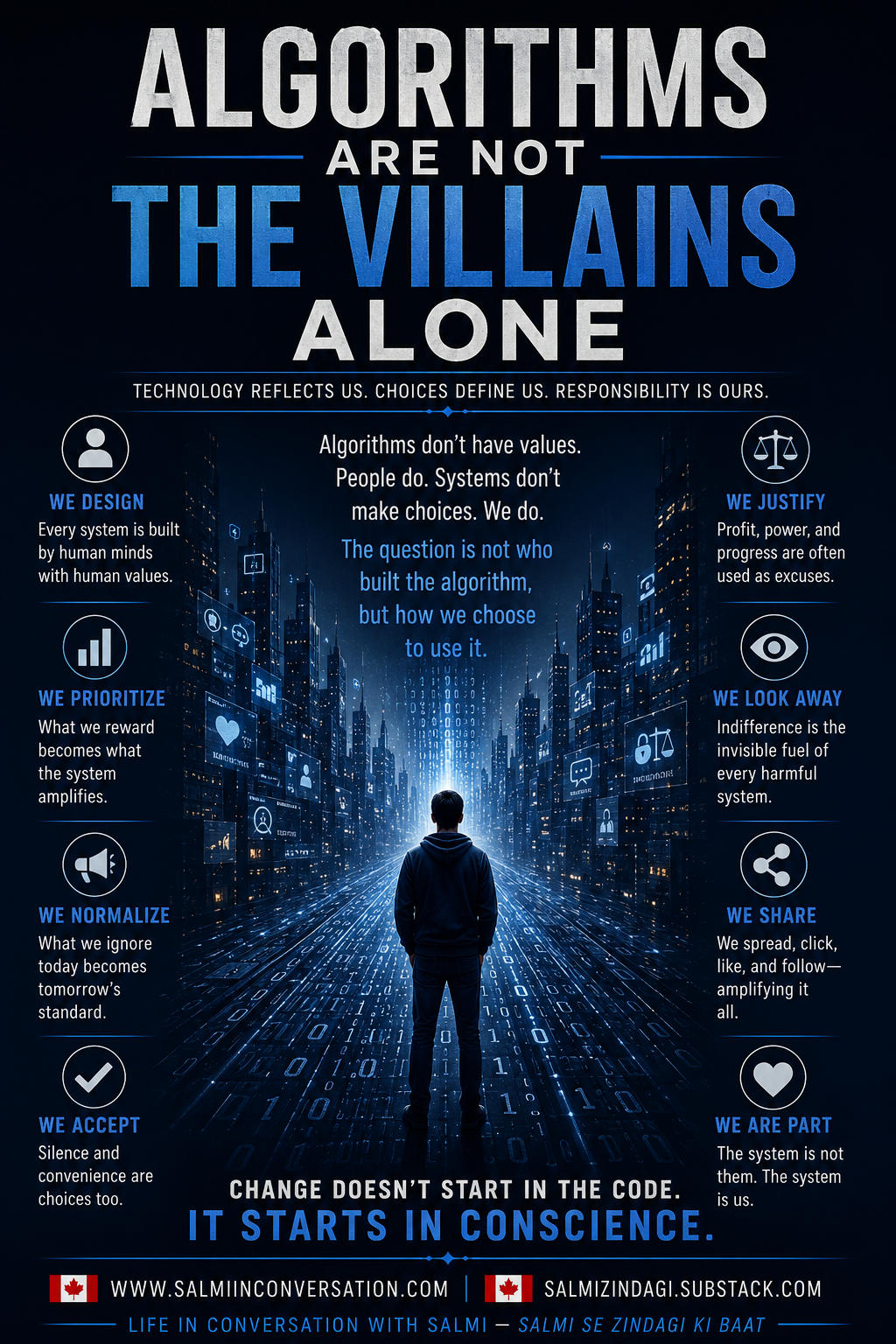
Algorithms Are Not the Villains Alone
It would be easy to blame technology alone.
But algorithms did not invent human ambition, vanity, fear, tribalism, greed, loneliness, ego, insecurity, or the desire for visibility.
Technology often amplifies what already exists.
The deeper question is not whether algorithms are evil.
The deeper question is:
What happens when humanity increasingly delegates attention, judgment, memory, validation, and meaning to systems designed primarily for optimization?
The danger may not be intelligence alone.
The danger may be humanity slowly surrendering moral responsibility while pretending neutrality.
The Drift Between Knowing and Caring
Modern civilization knows more than any civilization before it.
Yet knowledge alone does not guarantee wisdom, compassion, restraint, or understanding.
A society may become informationally advanced while emotionally fragmented.
Perhaps that is why contemporary humanity often feels caught between:
- awareness and numbness,
- visibility and invisibility,
- connection and isolation,
- intelligence and confusion.
The crisis may not be lack of information.
It may be the weakening relationship between knowing and caring.
Civilization and the Erosion of Sensitivity
Civilizations are not sustained by infrastructure alone.
They are sustained by moral sensitivity.
The ability to feel another human being as real.
The willingness to pause before harm.
The instinct to protect dignity even when efficiency suggests otherwise.
When sensitivity erodes, civilizations may continue functioning technologically while weakening spiritually, emotionally, socially, and morally underneath.
And perhaps this is the invisible contradiction of modern life:
humanity has become more connected operationally,
while often becoming more distant existentially.
Last Reflection — Before the Next Question Emerges
The future may not judge humanity only by what it created.
It may judge humanity by what it normalized while creating it.
Because civilizations rarely collapse only through violence.
Sometimes they slowly dissolve through:
- indifference,
- exhaustion,
- endless distraction,
- normalized compromise,
- emotional fragmentation,
- and the quiet disappearance of moral reflection from ordinary life.
The invisible lines are therefore not merely outside us.
They move within us.
Quietly.
Gradually.
Systemically.
And perhaps the most important question of this era is no longer simply:
What are we building?
But:
What are we becoming while building it?
Because civilization itself may survive.
Technology may survive.
Systems may survive.
But humanity —
humanity can quietly disappear from sight through its own arrogance of knowing everything while understanding very little.
And perhaps that is where this conversation truly begins —
not ends.
© 2026 Sulaiman Nasir | Life in Conversation with Salmi
All original writing, narration, and visual concepts remain the intellectual property of the author. Unauthorized reproduction, adaptation, distribution, or use of this work is prohibited.
🇨🇦 www.salmiinconversation.com
🇨🇦 https://salmizindagi.substack.com