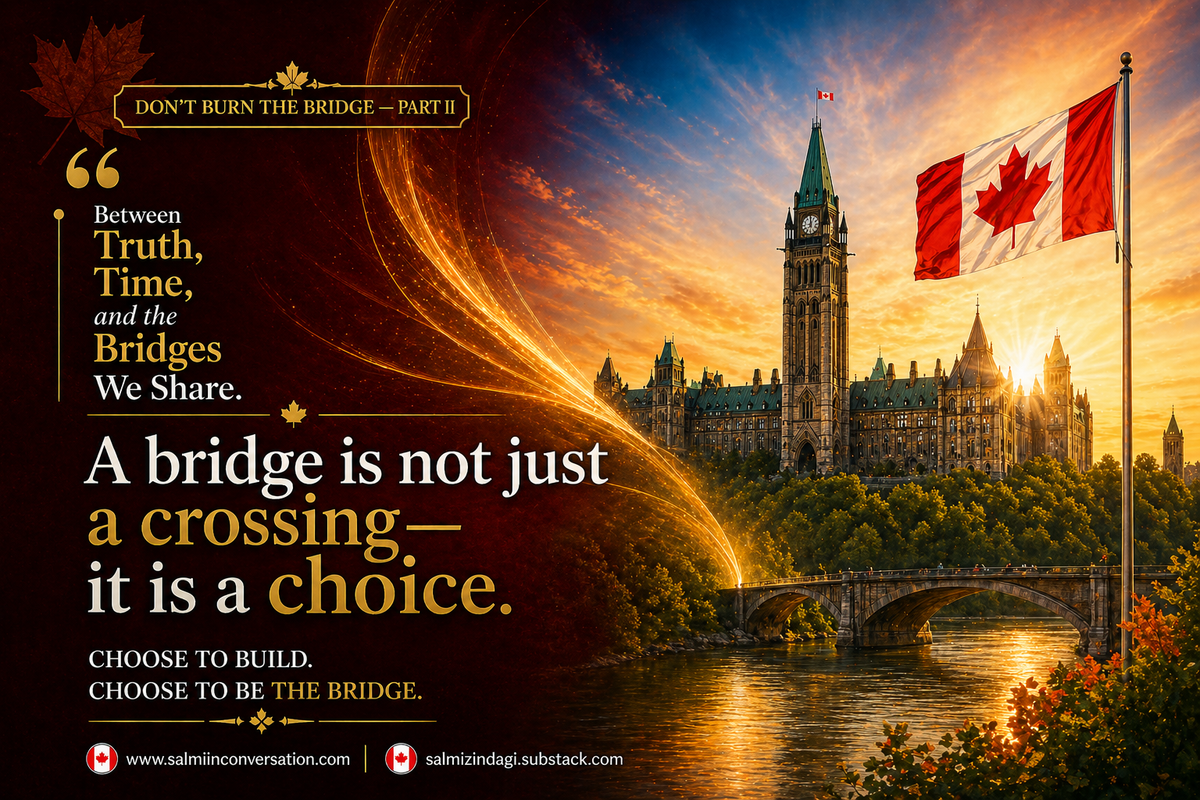
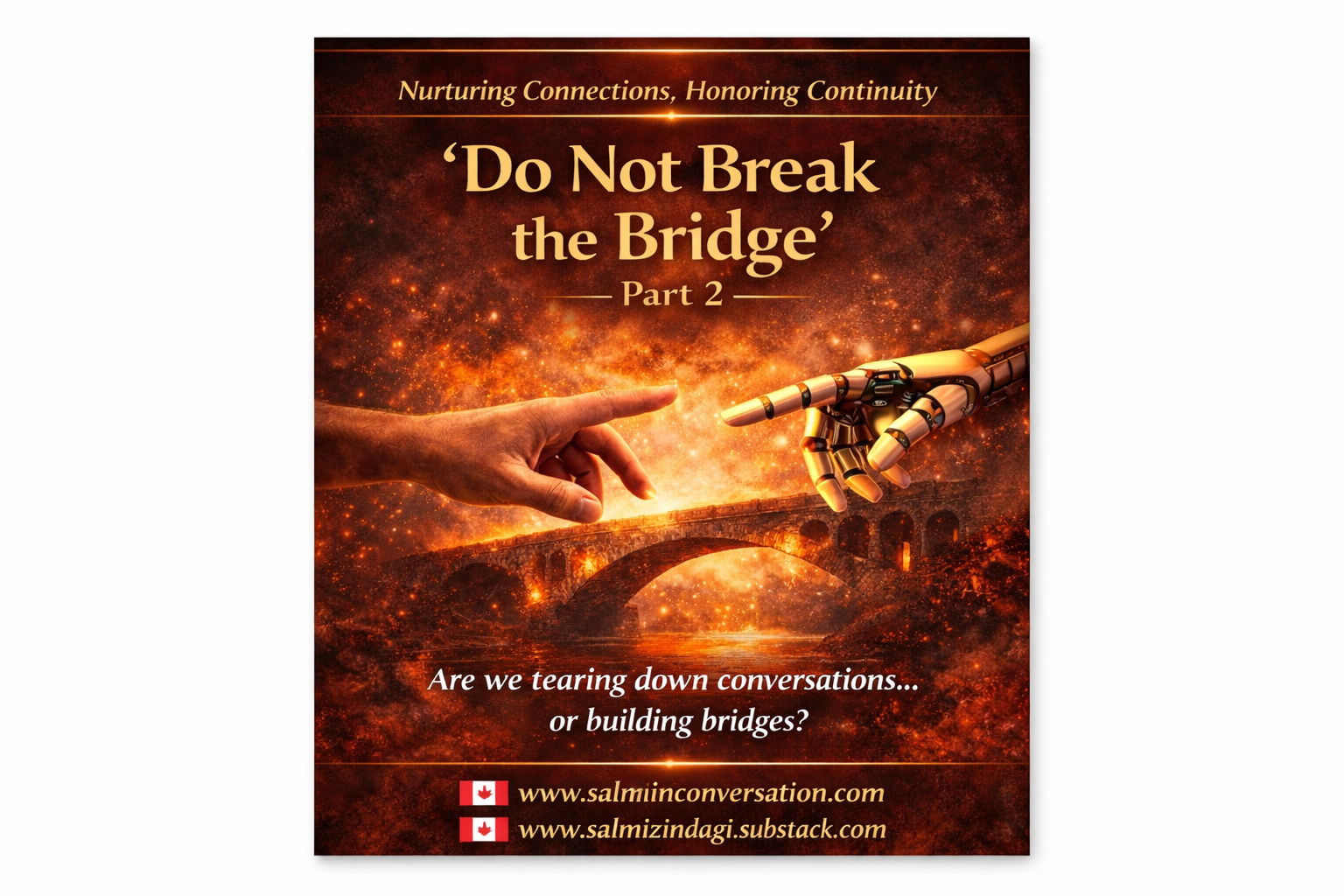
Don’t Burn the Bridge — Part II Between Truth, Time, and the Bridges We Share
In a time when narratives shift faster than truth, the real risk is not disagreement — it is the quiet erosion of trust. We often believe bridges are broken by conflict. More often, they disappear through indifference. A bridge is never just a structure — it is memory, trust, and shared humanity.

By: Sulaiman Nasir (Salmi)
A Conversation Returns
Before We Cross Further…This reflection continues from an earlier conversation:
Part I — Don’t Burn the Bridge
First published on Substack on February 26. Every bridge we speak of has a beginning.
If you wish to walk from where this conversation first began:
👉 https://salmizindagi.substack.com/p/dont-break-the-bridge
Some reflections return not to repeat themselves,
but to respond to their time.
Earlier this year, I wrote “Don’t Burn the Bridge” as a personal reflection.
At that time, the conversation reached a smaller circle.
Since then, that circle has grown — and so has the context in which this thought now lives.
This is not a repetition.
It is a continuation.
As conversations unfold around the building of new bridges —
not all of them grounded in truth —
one cannot help but notice how quickly narratives can shift.
This is not a political moment.
It is a human one.
A Bridge Beyond Structure
A bridge is never just an engineering achievement.
It represents years — sometimes generations —
of shared experience, mutual reliance, and quiet trust.
Families.
Communities.
Ideas.
Values.
These are the real crossings —
far more enduring than any structure.
When Narratives Drift from Reality
At times, narratives emerge that do not reflect lived reality.
They are shaped by:
- urgency over understanding
- positioning over perspective
- influence over insight
Such narratives can begin to:
- distort relationships
- weaken trust
- and quietly dehumanize what has long been shared
Not through confrontation —
but through repetition.
The Subtle Rise of “Us” and “Them”
What is most fragile in such moments is not disagreement.
It is the gradual shift toward otherness.
A language that separates:
- “we” from “they”
- certainty from curiosity
- assertion from understanding
In such a space, bridges are not visibly destroyed.
They are slowly redefined as unnecessary.
From Personal Advice to Collective Responsibility
What once felt like personal guidance
now stands within a much larger landscape.
We are not only risking bridges between individuals.
We are beginning to strain the bridges between:
- ideas and realities
- expectations and responsibilities
- memory and momentum
The bridge is no longer only relational.
It has become civilizational.
Economy Without Memory
In the urgency of economic pressures and fiscal realities,
something subtle is being lost.
We speak in numbers — growth, deficit, entitlement —
yet rarely in terms of continuity, responsibility, and shared burden.
When economics loses memory,
it becomes purely transactional.
And when it becomes transactional,
it begins to erode the very bridges that sustain trust.
The Philosophy of Otherness
There is a quiet philosophical rupture emerging.
Not loud.
Not always visible.
But deeply felt.
We are moving from:
- shared existence → divided identity
- collective memory → selective narrative
- lived experience → abstract positioning
In this shift, “the other” is no longer someone to understand —
but someone to define against.
And that is where bridges begin to burn without flame.
The Invisible Erosion
What makes this moment different
is not what we see — but what we fail to notice.
Character is becoming invisible.
Depth is becoming secondary.
Continuity is being replaced by immediacy.
We are beginning to minimize the weight of the last century
while overestimating the clarity of the present moment.
This creates a dangerous illusion:
That we understand more
simply because we speak louder.
The Strength We Already Carry
And yet, beneath all narratives,
there remains something far more stable.
The everyday goodness of people.
The quiet dignity of relationships.
The long memory of cooperation.
The instinct to move forward — together.
This is not constructed.
It is lived.
And it cannot be erased by temporary distortions.
Truth Has Its Own Patience
Phases shaped by noise, distortion, or imbalance
are rarely permanent.
They may feel overwhelming in the moment,
but they do not endure.
Because truth does not compete in volume —
it reveals itself over time.
And when it does,
it restores what was always there.
Beyond Blame — A Clearer Responsibility
There is no space here for a blame game.
No value in distorting reality through a cycle of convenient narratives.
It is easy to point toward systems, algorithms, or even the rise of Artificial Intelligence as the source of our current fractures.
But such explanations, while comforting, often move us away from responsibility.
Technology does not erode human values.
It reflects them.
It does not initiate division.
It amplifies what already exists within us.
The real question, therefore, is not what tools are doing —
but what we, as human beings, are choosing to do with them.
Human intelligence — with its capacity for reflection, restraint, and responsibility —
remains more than sufficient
to preserve what matters,
to protect what is shared,
and to honour what has been built over time.
The bridge does not weaken because of what surrounds it.
It weakens when we forget our role in sustaining it.
What “Not Burning the Bridge” Means Today
Today, “Don’t Burn the Bridge” carries a wider responsibility.
It is not about avoiding disagreement.
It is about protecting the human continuity beneath it.
It is about remembering that:
- relationships outlast narratives
- dignity outlasts division
- truth outlasts distortion
Not every voice needs to be answered.
But every bridge deserves to be preserved in understanding.
Toward What Comes Next
In the end, it may not be the bridges we built or burned that define us,
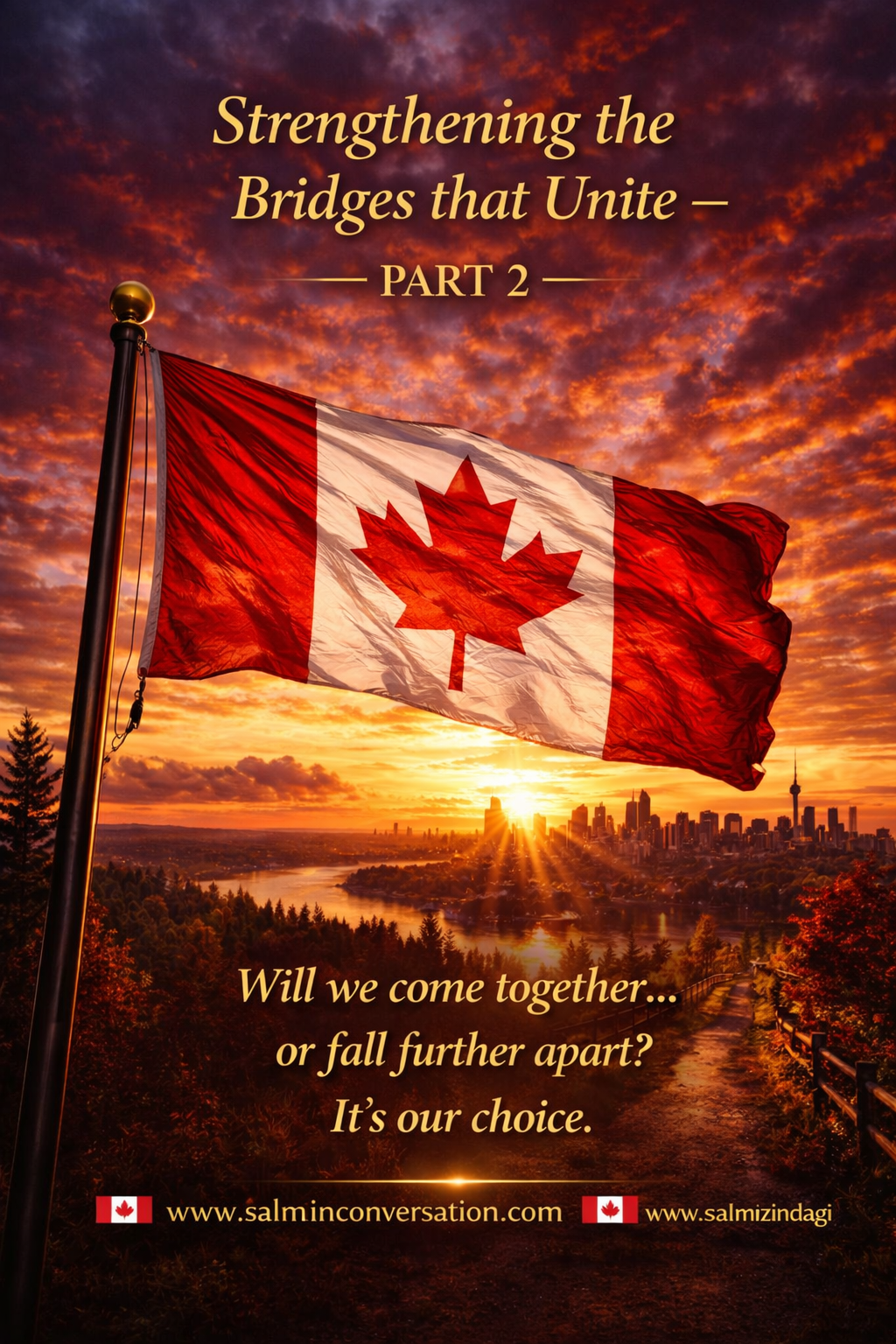
but whether we remembered why they were needed at all.
Perhaps what endures is not the bridge itself,
but our willingness to remain worthy of crossing it.
The future of every bridge rests not in its structure,
but in the character of those who choose to cross it.
And perhaps the true measure of our time
will be whether we chose to preserve what quietly held us together.
For bridges rarely disappear on their own —
they fade when we forget the humanity that once sustained them.
And if that is where we find ourselves today,
then perhaps the next conversation is not about bridges alone —
but about the humanity required to build, sustain, and become them.
This moment is asking something simple of us:
To see beyond what is being said
and remember what has always been lived.
Because bridges are not only built with structure —
they are sustained by people.
And as long as that remains intact,
no narrative can fully sever what has been built over time.
Bridges are not only structures between places—
they are silent agreements between hearts, histories, and hopes.
This conversation began earlier, and it will continue further.
If you wish to walk from where it first began:
👉 https://salmizindagi.substack.com/p/dont-break-the-bridge
Part III — The Bridge Within
Let’s continue the conversation.
© 2026 Sulaiman Nasir | Life in Conversation with Salmi
All original writing, narration, and visual concepts remain the intellectual property of the author. Unauthorized reproduction, adaptation, distribution, or use of this work is prohibited.
🇨🇦 www.salmiinconversation.com
🇨🇦 https://salmizindagi.substack.com