HI → AI → NI The Continuum of Intelligence From Reading Minds to Thinking Machines — and Beyond
Human intelligence created artificial intelligence. The next question is deeper: what new form of intelligence might emerge from their partnership? This one is very strong for thought-leaders and academics.

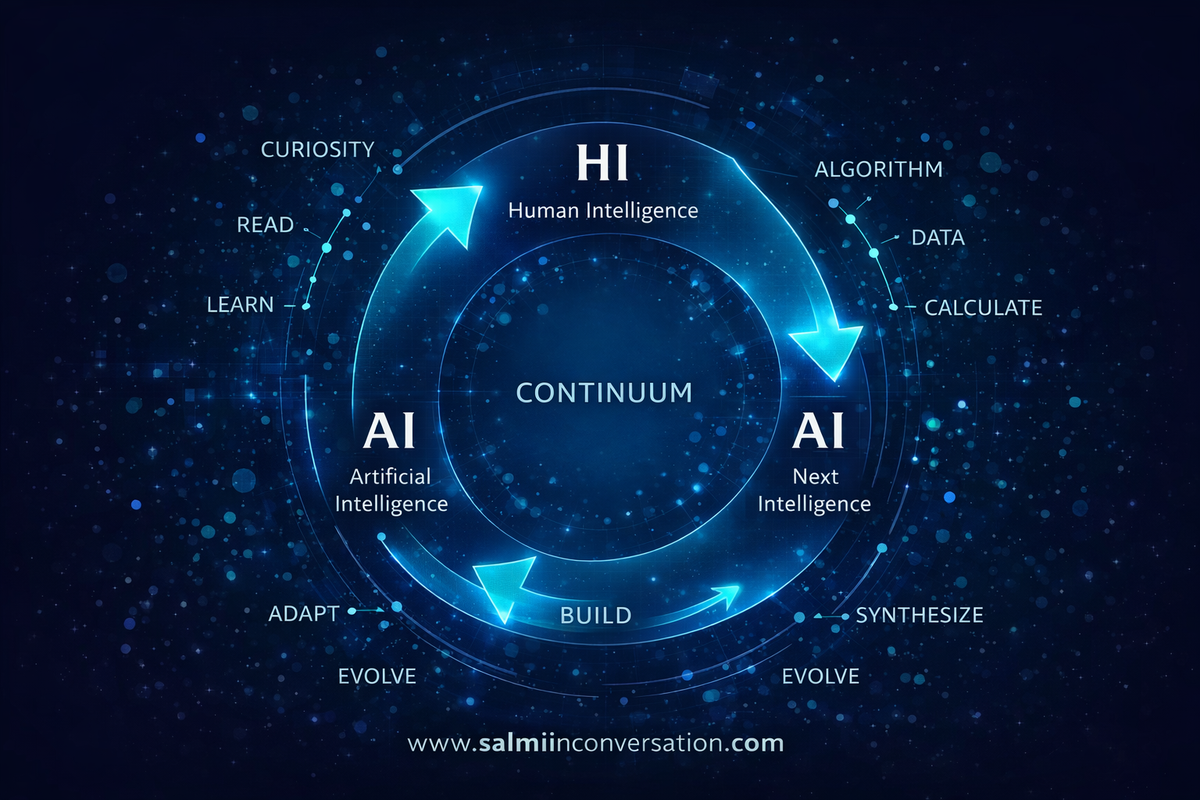
Human intelligence created artificial intelligence.
By Sulaiman Nasir (Salmi)
But perhaps that was never the full story — only the visible beginning.
The deeper question now is this: what new form of intelligence might emerge from their partnership?
Not as a replacement, but as a relationship. Not as an outcome, but as an unfolding.
From human curiosity and reading to artificial intelligence and the next evolution of collective intelligence, we find ourselves standing inside a quiet turning point — one that does not announce itself loudly, yet reshapes everything.
Every generation defines intelligence differently.
Every generation defines intelligence differently.
Once, intelligence meant reading deeply and thinking carefully. Knowledge traveled through books, teachers, stories, and lived experience. Learning required patience. Understanding required reflection.
Today intelligence is often measured in algorithms, data sets, and processing power. Machines calculate faster than humans ever could, and artificial intelligence increasingly participates in our decision-making.
But perhaps intelligence has always been something more continuous.
Human Intelligence gave birth to Artificial Intelligence.
And beyond both may lie something even larger — something still forming on the horizon.
A continuum.
Human Intelligence (HI).
Artificial Intelligence (AI).
And what may become the Next Intelligence (NI).
To understand where we are going, we must first return to where it all began.
HI — Where It All Began: Intelligence with a Word
The First Pulse of Human Intelligence
Read.
Four letters. One act. A seismic shift.
Before the first machine blinked, before the first algorithm calculated, before intelligence was measured in terabytes and training sets, there was us — tracing symbols, decoding stories, and expanding the universe inside our minds.
Reading was never passive.
It was — and still is — the first pulse of Human Intelligence (HI). We read not to store, but to understand. We read not to copy, but to question.
We read not to repeat, but to imagine.
Civilizations evolved not by conquest, but by concepts.
Reading taught us empathy before we named it, logic before we formalized it, and perspective before we understood how deeply we needed it.
This is where HI began — in libraries, not labs; in stories, not circuits. The pulse of intelligence started with curiosity, and curiosity breathed its first breath through reading.
Reading was — and remains — the greatest act of intellectual rebellion.
It is how we learn from the past, navigate the present, and design the future.
It is how knowledge leaps across time. It is how we, as humans, stay human.
“Read.” — It is not just how intelligence began.
It is how it continues.
AI — The Mirror We Built
The Partner We Need
We looked at the vastness of our own intelligence — our logic, language, memory, imagination — and wondered:
Can we build something that thinks with us?
So we did.
And we called it Artificial Intelligence.
AI was never meant to replace us. It was meant to reflect us — to become a mirror polished by data and sharpened by algorithms, one that shows us not only what we know but also what we don’t.
It does not dream, but it helps us pursue our dreams faster.
It does not feel, but it can help us understand feelings more deeply.
AI is a product of HI — a continuation, not a competitor.
It is the tool forged by centuries of human curiosity and the courage to ask better questions.
It amplifies our reach, accelerates our decisions, and extends our vision into realms we could never enter alone.
Collaboration, Not Competition
The real power of AI is unlocked when we stop treating it as a rival and start treating it as a collaborator.
Just as reading expanded the individual mind, AI expands the collective one.
It lets a doctor diagnose faster, an engineer design smarter, a poet write deeper, a policymaker plan wiser.
AI does not diminish us — it demands more of us.
It asks us to bring our best selves — our ethics, creativity, intuition, and empathy — to the table.
Because it learns from us, it inevitably becomes a reflection of us.
The question is not:
Will AI outthink us?
The question is:
Will we outgrow ourselves with AI?
Generation Z — The Builders of the Bridge
For Gen Z, AI is not a revolution — it is reality.
They don’t see it as an invention; they see it as an environment.
They are the first generation to collaborate with intelligence that doesn’t breathe — and they are redefining what learning, creating, and building mean.
This generation is not asking, “What can machines do?”
They are asking, “What can we do together?”
That question changes everything.
💡 AI is not the destination — it is the bridge.
It is how humanity moves from what we were to what we can become.
NI — The Next Intelligence
Where Humanity Evolves with Itself
Beyond AI lies a horizon we are only beginning to glimpse — a realm where intelligence is not coded, programmed, or taught, but emerges.
A world where technology is not simply a tool we use, but an environment we inhabit.
We call this NI — the Next Intelligence.
It will not be purely human.
It will not be purely artificial.
It will be something entirely new — a living ecosystem where biology, consciousness, environment, and computation weave together into a continuous intelligence.
This is the era the generation after Gen Z will inherit — a generation not just fluent in code but born inside it.
They will not distinguish between digital and physical, between human and machine, between knowledge and nature.
For them, intelligence will be everywhere — in the air we breathe, the homes we live in, the systems we rely on, the decisions we make.
From Creation to Co-Evolution
NI will not just answer questions — it will ask them.
It will not just support human decisions — it will co-shape them.
It will not merely respond to our curiosity — it will expand it.
But for this intelligence to serve humanity, it must be built on humanity.
The ethics, empathy, and wisdom we embed today will shape the consciousness of tomorrow.
If AI is the bridge, NI is the city on the other side — and what we choose to build there will determine whether that city becomes a utopia or a labyrinth.
💡 The Next Intelligence will not belong to machines or humans —
it will belong to both, and it will belong to all.
The Continuum
We All Belong to the Same Story
We often talk about “handing the future” to the next generation.
But the truth is:
We are not passing the torch.
We are extending the flame.
HI is the spark.
AI is the fire.
NI is the light that will illuminate the path ahead.
This is not a sequence of replacements.
It is a continuum of co-creation.
Every phase builds on the previous one.
Every generation extends the reach of the last.
Every word we read, every line of code we write, every system we design becomes part of a story far larger than ourselves.
A Call to All Generations
To our generation:
Teach the values that shaped the world.
Share the lessons that algorithms cannot learn.
Bring the wisdom that cannot be coded.
To Gen Z:
Build boldly, question constantly, and never stop exploring the boundaries of what intelligence can be.
To the Next Generation:
Do not simply inherit the future — invent it.
The journey from Read → Reflect → Reimagine is not over.
It is only the beginning.
💡 Intelligence is not a competition.
It is a continuum.
And we — all of us — are its keepers, its co-creators, and its custodians.
The Future Is Not Ahead — It’s Already Here
We stand in a moment where three forces — human, artificial, and next — are converging.
The boundaries between them are blurring, not to erase what came before, but to build what comes next.
The question is not whether we are ready.
The question is whether we are willing.
Willing to learn.
Willing to adapt.
Willing to create.
Willing to collaborate.
Because the future will not wait.
It is already unfolding — not somewhere far ahead, but within the choices we are making today, often without realizing their reach.
And when history looks back at this era, it will not remember only the machines we built or the algorithms we wrote.
It will remember the quality of intelligence we chose to embody.
Whether we allowed technology to distance us — or used it to deepen our humanity.
Whether we became faster — or wiser.
Whether we connected more — or understood more.
It will remember whether, in the presence of expanding intelligence, we remained deeply, unmistakably human.
Because in the end, the greatest question is not what intelligence becomes.
It is what we become within it.
And perhaps — just perhaps — that is where the real future begins.
Because the future will not wait.
It is already unfolding.
And when history looks back at this era, it will not remember the machines we built or the algorithms we wrote.
It will remember the intelligence we became — together.