Fearless Fear
Fear never guards the end. It only stands before the beginning. The Final Knock Before the Door Opens

Perhaps Fear Was Never the Enemy.
We spend much of our lives trying to escape fear—as though courage begins when fear disappears.
Yet life quietly tells a different story.
Every meaningful beginning seems to arrive accompanied by uncertainty.
Every new horizon asks for something that certainty never could.
Every door worth opening seems to wait behind one final conversation with fear.
Perhaps fear was never standing against us.
Perhaps it was the final knock before the door opened.
It is not empty.
It carries every question we brought with us.
We stand there with a hand almost raised—close enough to possibility to imagine it, yet far enough away to retreat without anyone knowing.
No one sees the conversation taking place within us.
Should I knock?
Should I wait?
What if it opens?
What if it does not?
What if the life I know is safer than the life I cannot yet see?
We are often told to become fearless before moving forward, as though courage begins only after uncertainty has disappeared.
But life rarely introduces its possibilities with certainty.
It places us before doors.
Some have names. Others do not.
Some appear as opportunities, relationships, ideas, departures, beginnings, or returns. Some have remained within us for years—not locked by anyone outside, but unopened because we kept waiting to feel completely ready.
And readiness, like tomorrow, has a habit of moving one day further away.
Perhaps fear does not always close the door.
Sometimes it simply persuades us not to knock.
The Hand That Pauses
Between intention and action lives a small, suspended moment in which an entire future can change direction.
The hand rises.
Then pauses.
Nothing dramatic has happened. No one has refused us. No path has collapsed. Yet the body remembers earlier disappointments, unanswered efforts, and doors that opened only to reveal another wall.
Fear borrows those memories.
It gathers them quietly and asks us to call hesitation wisdom.
Sometimes hesitation is wise. Not every door deserves entry. Not every invitation carries care. Not every opportunity respects the person it appears to welcome.
But sometimes hesitation is merely fear speaking in a more acceptable voice.
That is why courage cannot mean rushing forward without thought.
Courage listens.
It looks carefully.
It allows caution to speak—but does not allow caution to become the only voice in the room.
The hand that pauses is not weak.
It is human.
The question is whether the pause helps us see more clearly—or slowly becomes the place where possibility is buried.
Fear Does Not Always Shout
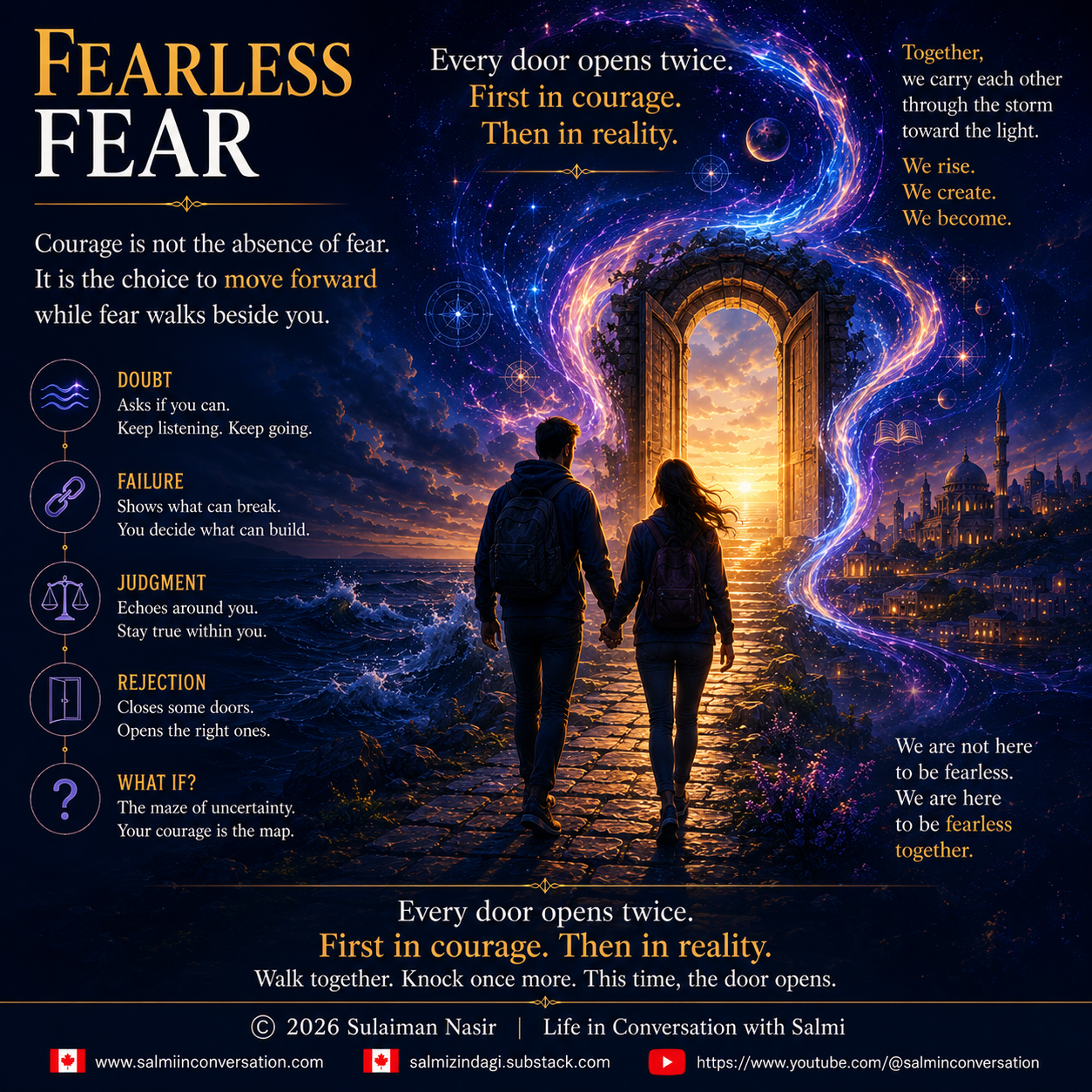
Sometimes fear arrives so softly that we mistake it for our own conclusion.
Fear is not always panic.
It does not always quicken the heartbeat or announce danger.
Sometimes it says:
Not yet.
Perhaps later.
You need more preparation.
Someone else belongs there more than you do.
It can sound reasonable because it rarely asks us to abandon the journey forever. It asks only for another day.
Then another.
And another.
Eventually, delay begins to resemble a decision we do not remember making.
This is where fearless fear acquires meaning.
It is not the elimination of fear. Nor is it a performance of bravery.
It is the moment we recognize fear without handing it complete authority.
Fear may remain in the conversation.
It simply does not get the final word.
What the Door Cannot Tell Us
A closed door is honest about one thing: it does not reveal what waits beyond it.
The door does not promise success.
It does not predict failure.
It stands between what we know and what has not yet been encountered.
The fear often comes not from the door itself, but from everything imagination places behind it.
Rejection.
Embarrassment.
Change.
The discovery that we are not ready.
Or perhaps the more unsettling discovery that we are ready—and life will no longer allow us to remain who we were.
But imagination need not belong exclusively to fear.
If it can construct rejection before the knock, it can also make room for possibility.
What if the answer redirects rather than rejects us?
What if the door opens differently from what we expected?
What if readiness is not something waiting inside us to become complete, but something formed through the courage to begin?
The unknown contains no guarantee.
It also contains no predetermined defeat.
Until we knock, both remain possible.
The Silence After the Knock
The first knock carries hope. The silence that follows tests its depth.
We knock once.
Nothing happens.
We knock again.
Still, the door does not move.
Silence has a strange power. It allows us to fill it with our own interpretation.
We call it rejection.
We call it failure.
We begin to believe that nothing is happening because nothing is visible.
Yet not every silence is an answer.
Some doors require time. Some require a different approach. Some direct us toward another entrance. Some remain closed because they were never ours to enter.
Persistence, therefore, cannot be reduced to repeatedly striking the same surface.
Persistence also listens.
It examines.
It learns.
It asks whether another knock is an act of courage, an act of impatience, or an invitation to change direction.
The final knock is not necessarily the loudest.
It may be quieter than all those that came before it—less desperate, more deliberate.
It does not demand that the door obey.
It simply refuses to let silence speak a language it may never have intended.
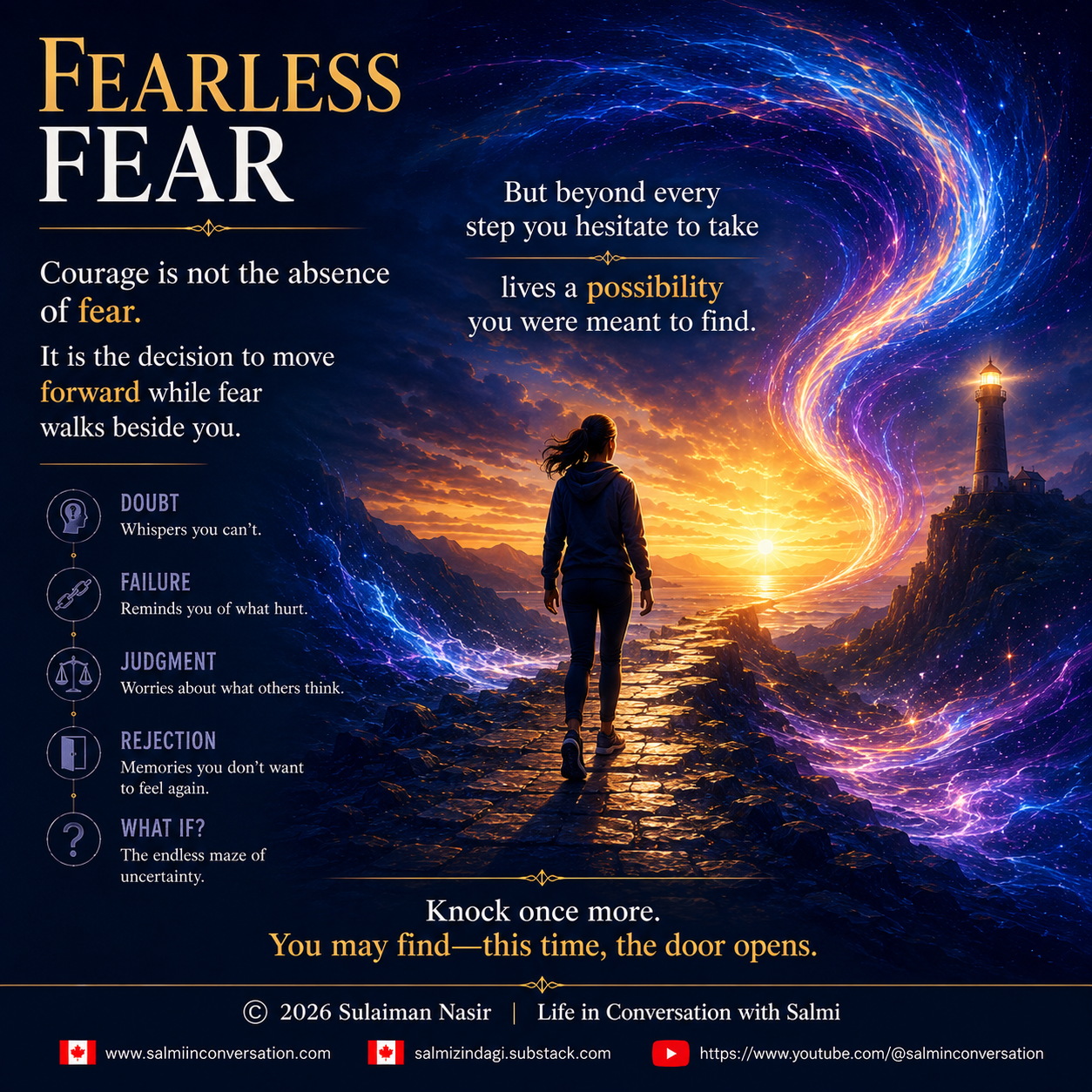
Not Every Door Must Open
A door can remain closed without turning the person before it into a failure.
It would be comforting to believe that courage is always rewarded with entry.
Knock sincerely.
Persist long enough.
Believe deeply enough.
And the door will open.
But life does not offer such a simple exchange. Courage is not a transaction in which effort purchases a guaranteed outcome.
Some doors open.
Some do not.
Some reveal a path we could never have imagined.
Some protect us through their refusal.
Others teach us that we have spent too long requesting admission to a place that was never capable of receiving us.
The meaning of the knock cannot depend entirely upon what happens next.
There is already meaning in giving reality an opportunity to answer.
Without the knock, fear answers on reality’s behalf.
And when a door remains closed, the journey has not necessarily ended. The architecture of life contains more than one entrance.
Sometimes the next step is not another knock.
Sometimes it is turning around and finally noticing the horizon behind us.
Dignity at the Threshold
Human dignity begins where self-worth stops bargaining for admission.
Dignity does not knock.
Courage may raise the hand, but dignity reminds us that our worth is not waiting on the other side for someone else to confirm.
Human dignity does not require us to prove ourselves before every closed door.
It does not ask us to keep knocking where our humanity is repeatedly diminished.
It does not confuse endurance with self-erasure.
Dignity preserves our freedom to choose.
To knock again.
To wait.
To seek another path.
To walk away without considering departure a defeat.
Or to build a door where none existed—and hold it open for someone arriving after us.
A closed door may limit access.
It cannot define the person standing before it.
That distinction matters.
Otherwise persistence becomes pleading, opportunity becomes permission, and success becomes something granted only by those already inside.
The deepest courage may be knowing when another knock honours possibility—and when walking away protects the soul.
The Knock No One Hears
Long before the hand reaches the door, something quieter must open within us.
Perhaps the most important knock is not heard outside.
It occurs within—the moment hesitation is acknowledged but no longer permitted to become destiny.
There may be no sudden confidence.
No disappearance of doubt.
No assurance that the door will open.
Fear may still accompany us to the threshold.
But something within us has changed.
We are no longer waiting for fear to leave before allowing life to continue.
We have begun to understand that courage is not certainty.
It is movement without complete certainty.
It is curiosity refusing to surrender the unknown entirely to fear.
It is hope remaining intelligent rather than becoming blind.
It is dignity protecting the freedom to choose our next step.
Perhaps this is fearless fear.
Not the conquest of every uncertainty.
Not a promise that every door will open.
Not a performance of strength.
It is a more honest relationship with the unknown—one in which fear may speak, but cannot silently decide the life we never attempted to enter.
The hand rises.
The silence remains.
The future is still unseen.
The human moment before meaning is chosen.
There is a particular silence outside a closed door.
And the question waits with us at the threshold:
Will the unknown silence your knock—or awaken your courage?
© 2026 Sulaiman Nasir | Life in Conversation with Salmi
🇨🇦 www.salmiinconversation.com
🇨🇦 salmizindagi.substack.com
▶️ YouTube — Salmi in Conversation
Conversation with Salmi — All original writing, narration, and visual concepts remain the intellectual property of the author. Unauthorized use, reproduction, or adaptation of this work is prohibited.