Three Everyday Phrases — Three Quiet Questions About the Modern World

Sometimes the most ordinary phrases reveal the most important questions.
Rollover, the Bottom Line, and Bare Bones
By Sulaiman Nasir (Salmi)
Language has a quiet way of revealing the deeper structures of our thinking.
Many of the phrases we use every day appear simple. They move easily through conversation, business meetings, and casual reflections. We rarely stop to examine them. Yet hidden within these ordinary expressions are entire philosophies about how we see the world.
Sometimes a single phrase can expose assumptions about power, value, progress, or simplicity.
Three such phrases have been quietly circling my thoughts recently:
Rollover.
The Bottom Line.
Bare Bones.
At first glance they seem unrelated. One belongs to finance, another to accounting, and the third to everyday speech about simplicity.
But when we pause long enough to listen carefully, they begin to reveal something deeper about how modern life operates.
They are not merely expressions.
They are small windows into how decisions are made, how systems continue, and how complexity hides beneath the surface of simplicity.
Rollover or Rollunder — The Quiet Question of Choice
In financial language, the term rollover is familiar. Debts are rolled over. Investments are rolled over. Contracts are extended forward.
The idea is simple: instead of resolving something now, we carry it forward into the future.
But rollover is not limited to finance. It is everywhere.
Organizations roll over policies from previous decades. Institutions roll over assumptions inherited from earlier generations. Even individuals roll over habits and beliefs formed long ago.
The past quietly slides into the present.
Sometimes this continuity is useful. Tradition can provide stability. Experience can guide decisions.
Yet rollover also contains a hidden risk: problems may travel forward without ever being examined.
The opposite reaction can also occur. Under pressure, people and institutions sometimes roll under — bending beneath forces they feel unable to challenge.
Instead of questioning the direction of events, they adapt to it.
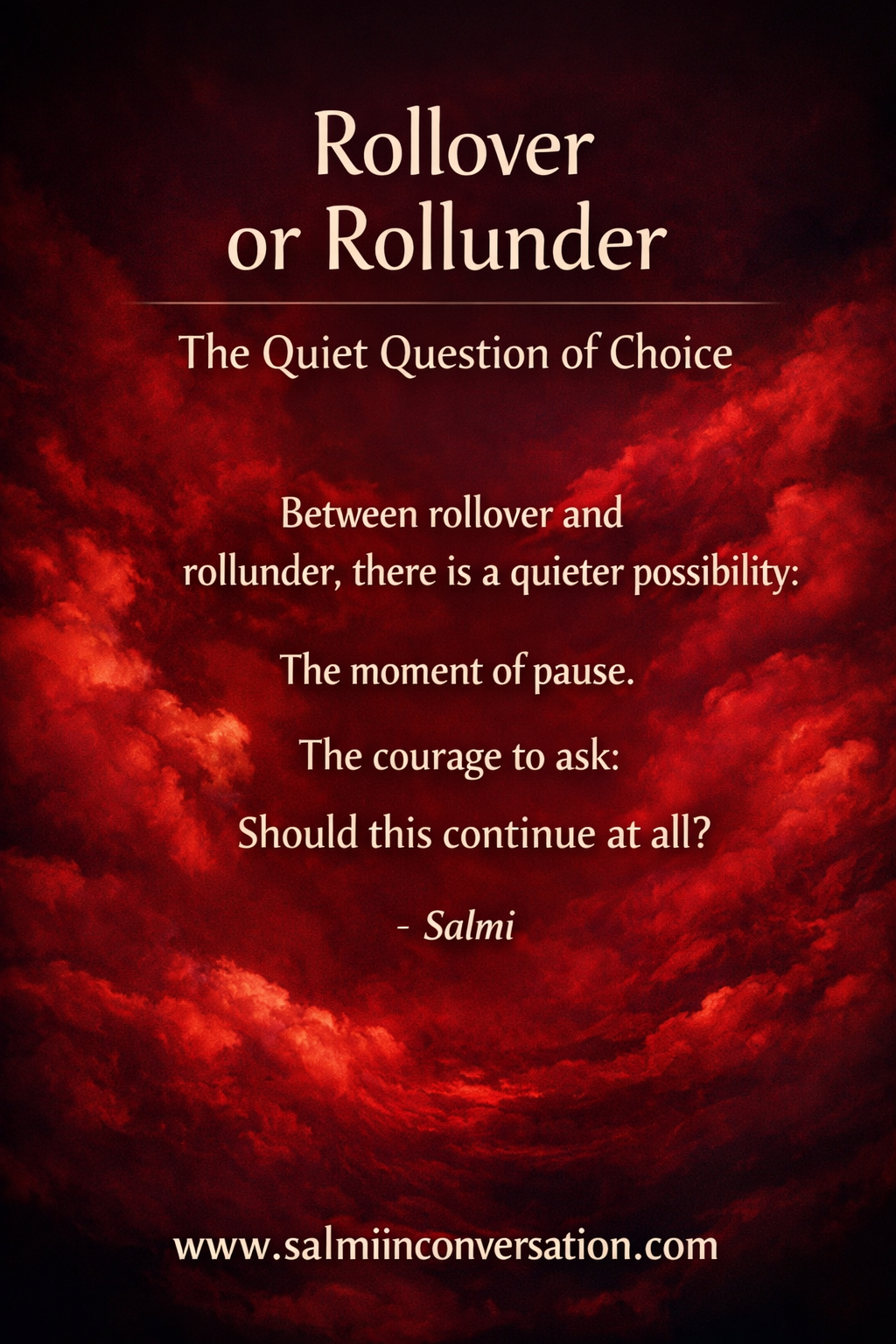
Between rollover and rollunder lies a quieter possibility:
the moment of pause.
A pause is rarely dramatic. It simply asks whether movement itself is necessary.
Should this continue?
Not every inherited structure deserves automatic continuation. Not every pressure deserves automatic submission.
Sometimes wisdom begins with the courage to stop long enough to ask whether the path itself still makes sense.
The Bottom Line — What Is It and What For?
Few phrases carry more authority in modern decision-making than the bottom line.
In accounting, the bottom line is the final number. It represents profit or loss — success or failure.
The clarity of this number gives it enormous power.
Businesses rely on it. Governments measure policies through it. Entire industries rise and fall according to it.
But beneath this clarity lies a deeper question.
Every system must decide what counts as its bottom line.
Profit may be the most obvious choice, but it is far from the only one.
Some institutions measure success through growth. Others through efficiency. Some through social impact. Others through influence or reputation.
Even individuals quietly choose their own bottom lines.
For one person it may be financial security.
For another it may be intellectual freedom.
For someone else it may be service, family stability, or the ability to live with integrity.
What makes the bottom line powerful is not the number itself.
It is the decision that precedes the number.
The moment when a system chooses what it will measure.
Once that choice is made, everything else begins to align around it.
Resources follow the measurement. Incentives follow the measurement. Behaviour gradually adapts to the measurement.
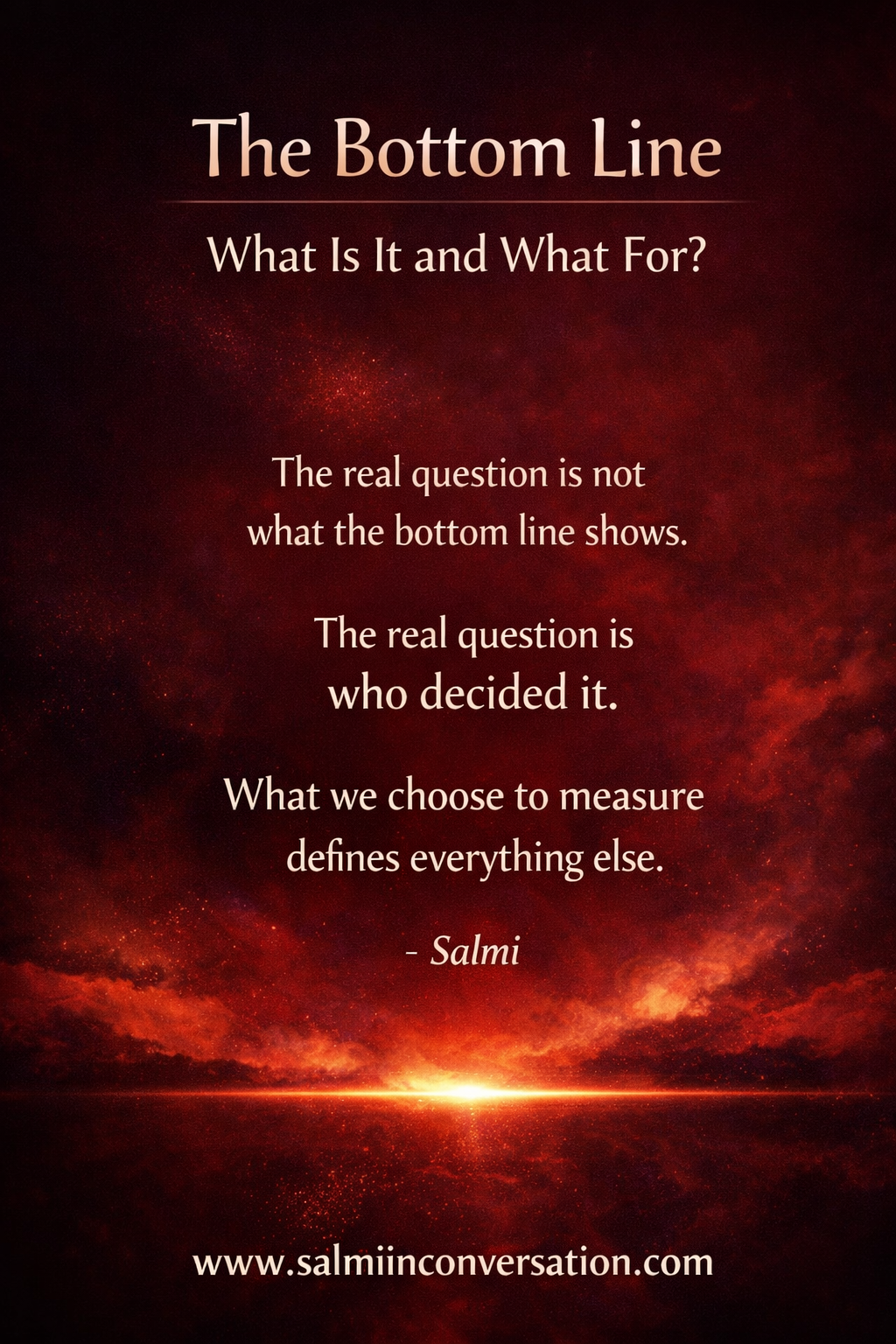
The real question is not what the bottom line shows.
The deeper question is who decided it.
Because when a society chooses its bottom line, it quietly determines the direction of its priorities.
Bare Bones — Simplicity in the Age of Invisible Complexity
The phrase bare bones once meant something very clear.
It referred to something stripped down to its essentials — containing only what was necessary.
In earlier times, simplicity was visible. A simple tool looked simple. A simple system appeared uncomplicated.
But the modern world has quietly changed the meaning of simplicity.
Consider the small device resting in a person’s hand today.
A smartphone appears minimal in design — a smooth screen, a few icons, a clean interface.
From the outside it seems almost bare bones.
Yet behind that small screen lives an immense invisible architecture.
Cloud computing networks.
Data centres across continents.
Algorithms processing enormous flows of information.
Satellites and fibre optic cables spanning the globe.
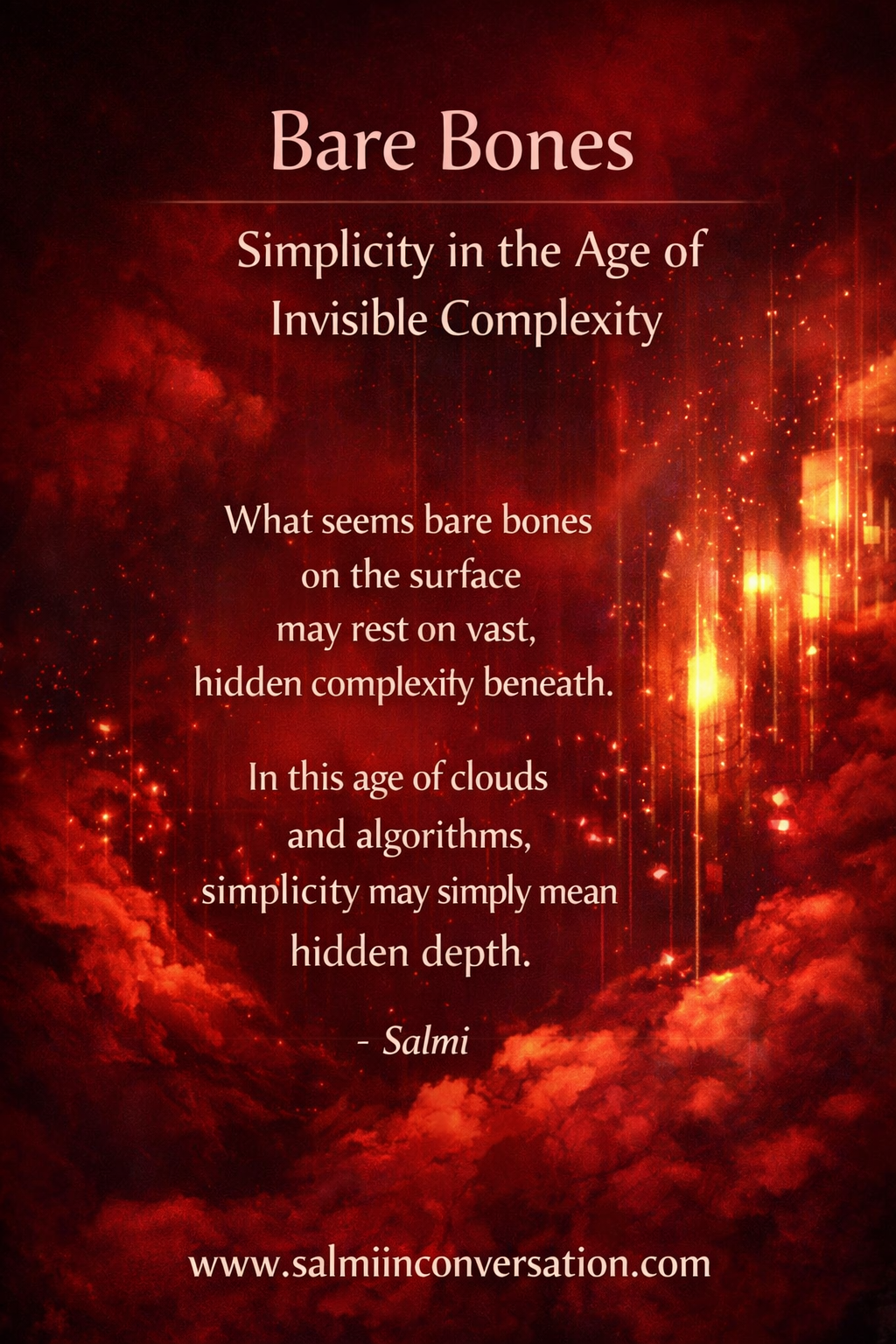
What appears simple on the surface often rests upon vast systems beneath.
The same pattern can be seen across modern life.
A single search activates global infrastructures.
A short message travels through networks built over decades.
A simple click may trigger artificial intelligence trained on oceans of data.
The simplicity we see is often supported by complexity we do not.
This does not make simplicity meaningless.
It simply means that simplicity today often rests upon hidden depth.
Recognizing that hidden architecture may help us develop a wiser relationship with the technologies shaping our lives.
Three Phrases — One Reflection
At first glance, rollover, the bottom line, and bare bones appear to belong to different conversations.
Yet they share a common thread.
Each phrase reveals a moment where human choices quietly shape the systems around us.
Rollover reminds us that the past can continue forward without examination.
The bottom line reminds us that measurement determines direction.
Bare bones reminds us that apparent simplicity often conceals deeper complexity.
Together they invite a more attentive way of thinking.
Instead of accepting inherited structures automatically, we can pause.
Instead of assuming numbers tell the whole story, we can reflect on the values behind them.
Instead of mistaking simplicity for absence, we can recognize the hidden architectures sustaining modern life.
Language, after all, is not merely a tool for communication.
It is also a mirror reflecting how we think.
Sometimes the most ordinary phrases reveal the most important questions.
—
Member discussion