It’s Better to Light a Candle Than Curse the Darkness Seeing, Not Merely Watching
By Sulaiman Nasir (Salmi)
There is an old Chinese proverb that quietly survives across generations:
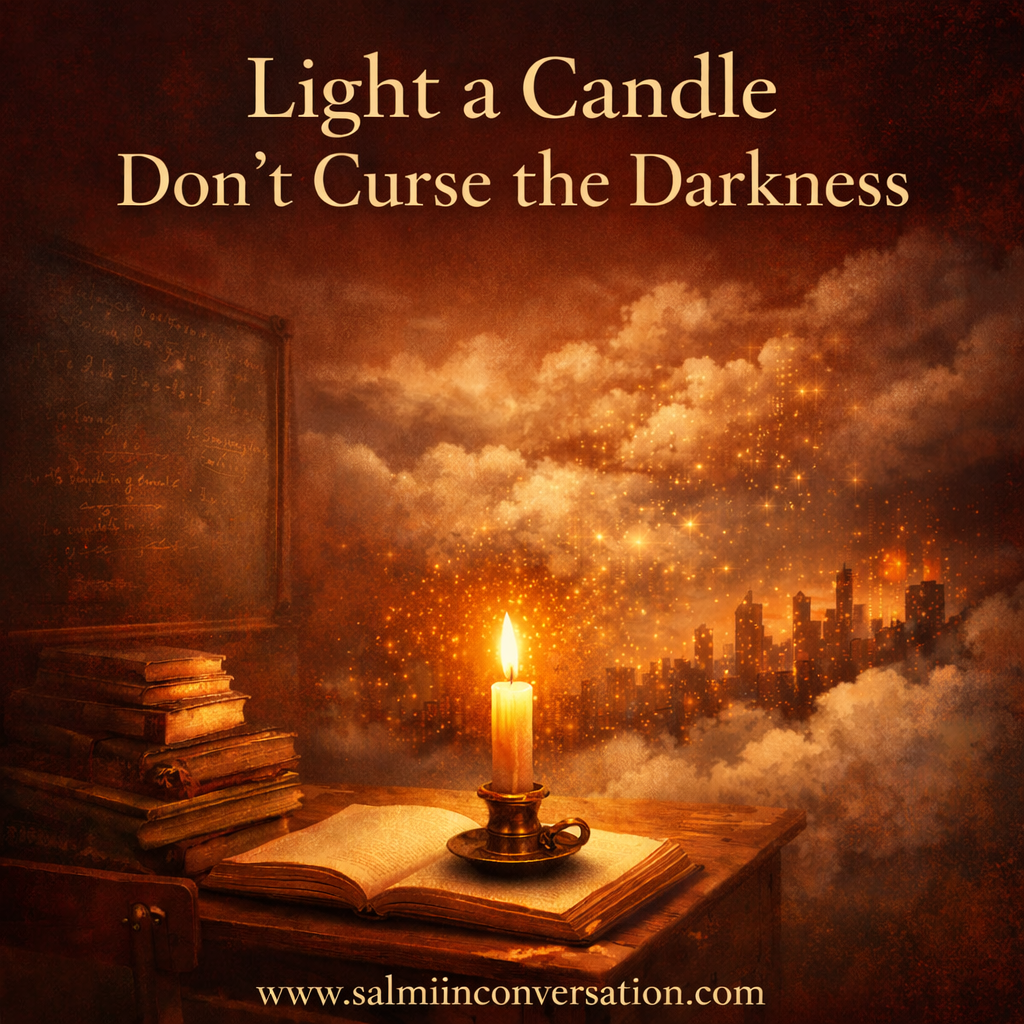
It is better to light a candle than to curse the darkness.
At first glance, the wisdom appears simple — almost obvious. Yet its depth reveals itself only through experience. Darkness is not merely the absence of light; it is often the presence of uncertainty, fear, frustration, or helplessness.
Every life encounters moments when circumstances feel beyond control. Institutions fail expectations, plans collapse, and the future appears obscured. In such moments, the instinct to complain feels natural. We speak of what is missing, what is unfair, or what should have been different.
But the proverb suggests another response — quieter, yet transformative.
Light something.
The Difference Between Watching and Seeing
Modern life encourages observation without engagement. We watch events unfold endlessly — through screens, conversations, and commentary — yet watching alone rarely changes reality.
Lighting a candle requires participation.
It is an action, however small, that alters the environment. A single flame does not eliminate darkness entirely, yet it changes how we experience it. Shapes emerge. Direction becomes visible. Fear softens into awareness.
The candle does not compete with darkness.
It simply refuses to surrender to it.
In this refusal lies dignity.
Small Acts, Enduring Meaning
Human history rarely advances through grand gestures alone. Progress often begins with modest acts performed consistently — a teacher encouraging curiosity, a parent offering patience, a colleague choosing integrity, or a stranger extending kindness without recognition.
These acts resemble candles.
They do not announce themselves loudly. They illuminate quietly, allowing others to move forward with greater confidence.
We sometimes underestimate small contributions because they lack spectacle. Yet light does not measure its worth by size; it measures it by clarity.
Hope as Responsibility
Hope is often misunderstood as passive optimism — waiting for circumstances to improve. But genuine hope carries responsibility. It asks us to become participants in improvement rather than observers of decline.
Lighting a candle is not denial of darkness. It is acknowledgment paired with action.
The world does not require each of us to solve every problem. It asks only that we illuminate the space within our reach — our work, our relationships, our communities, and our thoughts.
Even limited light creates orientation.
When the Candle Is Within
Over time, one discovers that the most important candle is internal.
External achievements fluctuate. Recognition fades. Circumstances change. Yet an inner orientation toward meaning — toward kindness, curiosity, and resilience — continues to guide us when external certainty disappears.
The candle becomes less an object and more a way of living.
A decision to respond with awareness rather than despair.
Closing Reflection
Perhaps the wisdom of the proverb lies not in solving darkness, but in transforming our relationship with it.
When we light a candle, we begin to see rather than merely watch. We recognize that even in uncertain times, participation remains possible.
And sometimes, the smallest flame reveals the path more clearly than the brightest daylight ever could.
— Salmi
Life in Conversation with Salmi
www.salmiinconversation.com
Member discussion